
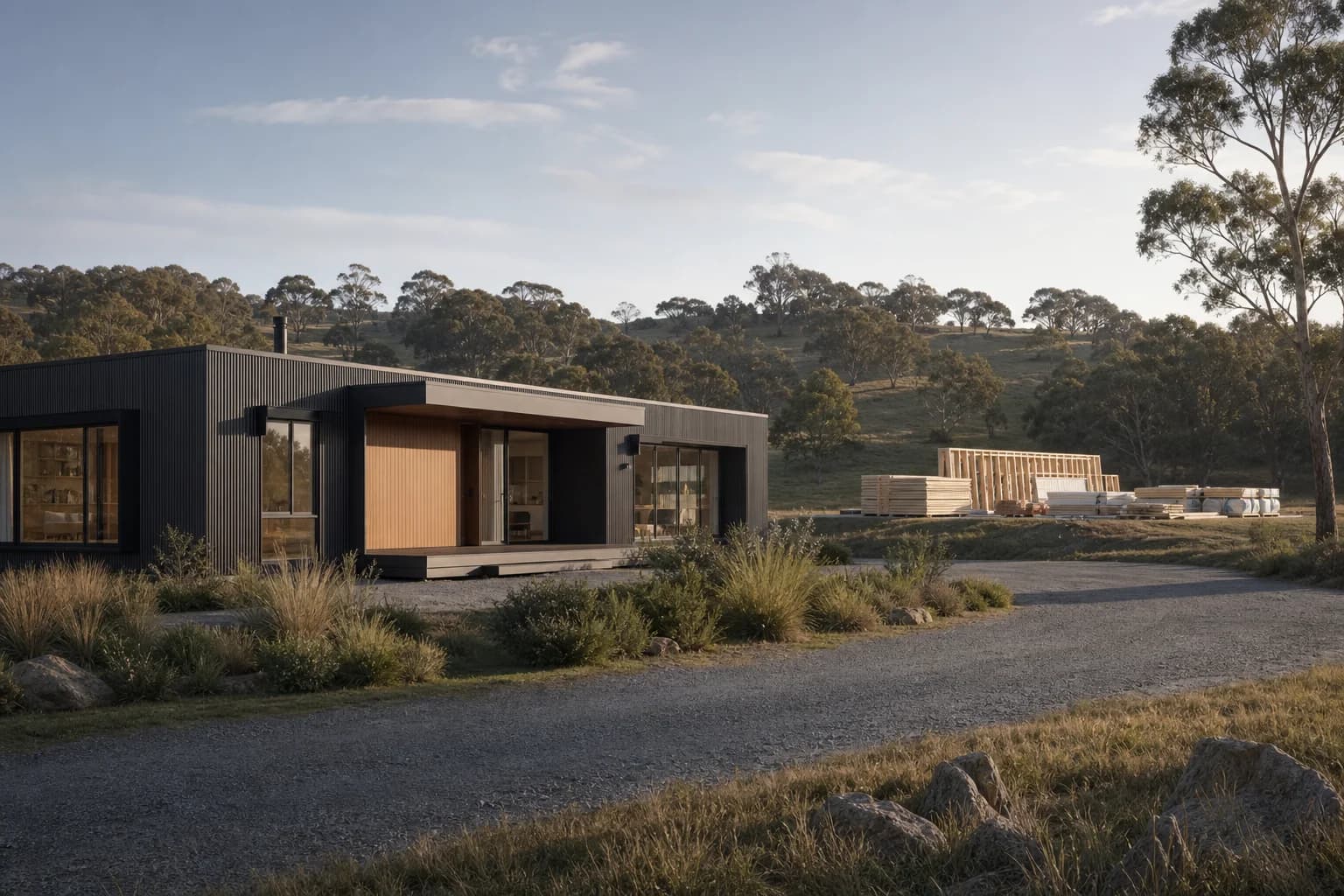
They sound similar, they're often priced against each other, and buyers regularly confuse the two — but a modular home and a kit home are fundamentally different things, and choosing the wrong one for your situation can cost you far more than the price difference on paper. The gap comes down to one question: who builds it, and where? This guide breaks down exactly how modular and kit homes differ across cost, effort, approval, finance and quality, so you know which one actually fits what you're trying to do.
The core difference in one line
A modular home arrives built — assembled in a factory and delivered to your site largely complete. A kit home arrives as a flat-pack of materials and components that then has to be built on your site, by you or by builders you engage.
Everything else — cost, timeline, effort, finance — flows from that single distinction. One is a finished home delivered; the other is a set of parts to assemble.
Modular vs kit home: side by side
| Modular home | Kit home | |
|---|---|---|
| What arrives | A built home, largely complete | A flat-pack of materials |
| Who builds it | The factory | You, or builders you engage |
| On-site work | Placement and connection | Full construction |
| Build time on site | Days to weeks | Months |
| Your involvement | Low | High (or you manage trades) |
| Cost | Higher upfront | Lower upfront (excludes labour) |
| Finish quality | Factory-controlled | Depends on who builds it |
| Best for | Turnkey, hands-off | Owner-builders, hands-on |
What is a modular home?
A modular home is built in sections (modules) in a factory, transported to your site, and installed largely complete — often with kitchens, bathrooms, wiring and finishes already done. The bulk of the construction happens off-site under controlled conditions, and the on-site work is placement, connection and finishing.
The appeal: speed, certainty and low involvement. You're buying a finished home, not managing a build. Factory construction means a fixed price, no weather delays, and consistent quality. Once permanently installed, it's classified as a Class 1a dwelling — identical to a conventional house for approval, finance and resale.
The trade-off: you pay more upfront than a kit home's material cost, because you're paying for the home to be built, not just supplied.
What is a kit home?
A kit home is a package of pre-cut, pre-engineered materials and components — the frame, cladding, roofing, and often fittings — delivered flat-packed to your site with plans and instructions. From there, it has to be assembled into a home. Some owner-builders do much of this themselves; others engage builders and trades to construct it.
The appeal: a lower upfront price and control over the build. For a capable owner-builder, a kit home can be a genuinely economical way to build, because you're saving on the labour of construction.
The trade-off: the advertised price is materials only. The real cost includes all the labour to build it — either your time and skill, or the trades you pay. And the finished quality depends entirely on who does the building. A kit home is a project, not a product.
The cost comparison people get wrong
This is where buyers are most often caught out. On paper, a kit home looks dramatically cheaper than a modular home. But you're comparing two different things:
- 01A modular home price includes the labour and factory work to build the home
- 02A kit home price is the materials — the labour to build it is on top
Add the construction labour to a kit home — whether that's paying trades or valuing your own time — and the gap narrows significantly, sometimes disappearing. For an owner-builder with the skills and time, a kit home can still come out cheaper. For someone who has to pay builders to assemble it, the total cost can approach or exceed a modular home, without the speed or certainty.
The honest comparison isn't sticker-to-sticker. It's total cost to a finished, approved home — including labour, time, and the risk of a build that runs over.
Approval and finance differences
Both modular and kit homes, once permanently built to standard, are Class 1a dwellings requiring the same council approval as any house. But there are practical differences:
- 01Finance. A modular home from an established supplier often has clearer finance pathways. Kit homes, especially owner-built, can be harder to finance — lenders may be cautious about owner-builder projects and staged construction.
- 02Owner-builder responsibility. Building a kit home yourself usually means taking on owner-builder obligations — permits, insurance, and liability for the build meeting standards. That's a significant responsibility a modular home avoids.
- 03Certification. A modular home is certified through a controlled process. A kit home's compliance depends on the build being done correctly on site.
Which should you choose?
A modular home suits you if:
- 01You want a finished home with minimal involvement
- 02Speed and price certainty matter
- 03You'd rather not manage trades or take on owner-builder responsibility
- 04You value factory-controlled, consistent quality
A kit home suits you if:
- 01You're a capable owner-builder with time and skills
- 02You want maximum control over the build
- 03Lowering upfront material cost is the priority and you can supply the labour
- 04You're comfortable taking on owner-builder obligations and managing the project
Neither is universally better. The question is whether you want to buy a home or build one.
Frequently asked questions
What's the difference between a modular home and a kit home?
A modular home is built in a factory and delivered largely complete — you're buying a finished home. A kit home is a flat-pack of materials delivered to your site that then has to be assembled into a home, by you or builders you engage. The modular home price includes the labour to build it; the kit home price is materials only.
Are kit homes cheaper than modular homes?
Kit homes have a lower upfront price because it covers materials only, not the labour to build them. Once you add construction labour — paying trades or valuing your own time — the gap narrows and can disappear. For a capable owner-builder, kit homes can still be cheaper; if you're paying builders to assemble it, the total can approach a modular home without the speed or certainty.
Do kit homes and modular homes need the same council approval?
Yes. Once permanently built to standard, both are Class 1a dwellings requiring the same council approval as any house. The practical difference is that building a kit home usually means taking on owner-builder responsibilities — permits, insurance and liability for meeting standards — while a modular home is certified through a controlled process.
Can you get finance for a kit home in Australia?
It can be harder than for a modular home. Lenders are sometimes cautious about owner-builder projects and staged construction, which is how many kit homes are built. A modular home from an established supplier often has clearer finance pathways. Speak to a broker experienced with the type of build you're planning.
Is a kit home good quality?
A kit home's quality depends entirely on who builds it and how well. The materials are pre-engineered, but the finished result reflects the skill of the person assembling it. A modular home, by contrast, is built under controlled factory conditions with consistent quality regardless of site.
The bottom line
The difference between a modular home and a kit home isn't a detail — it's the whole nature of what you're buying. A modular home is a finished product delivered to your site; a kit home is a project you build. One prioritises speed, certainty and low effort; the other prioritises lower material cost and owner control. Compare them honestly — total cost to a finished home, not sticker to sticker — and the right choice usually becomes obvious based on how much of the build you want to take on yourself.
ModuHaus builds permanent, architect-designed modular homes — finished homes delivered to your site, not kits to assemble. If you want to understand which approach suits your project, budget and site, a Planning Assessment is the place to start.
**Start your Planning Assessment →**
This article is general information only and not legal, financial or building advice. Requirements and costs vary by state, site and supplier. Always confirm specifics with your council, a registered building surveyor and your lender before proceeding.
Last updated: 16/07/2026.
Sources and further reading
Requirements change and can be applied differently by site and local authority. Check the current official sources and confirm your project with the relevant council, certifier or qualified professional.