
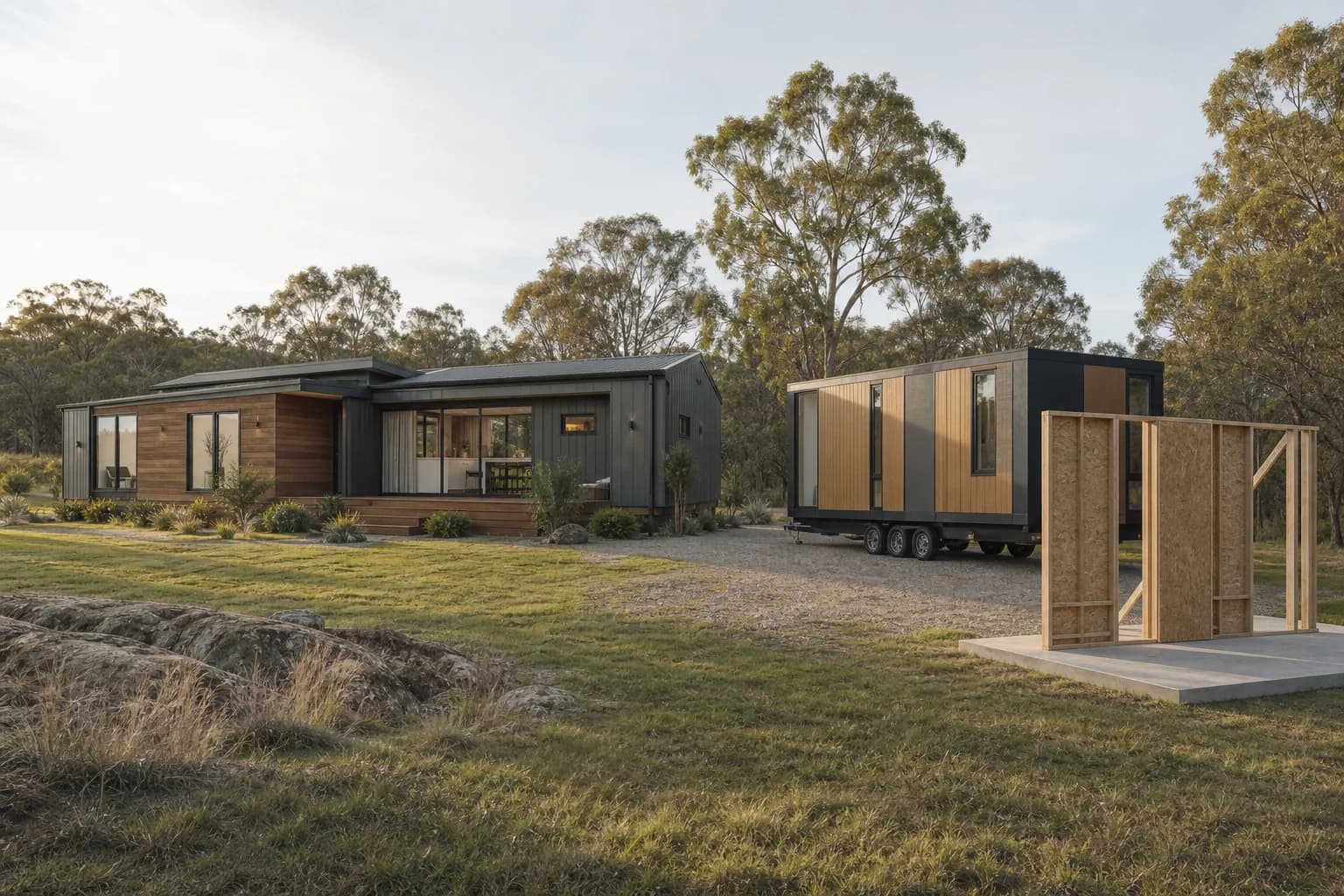
Prefab. Modular. Manufactured. Transportable. Relocatable. Kit. These terms get used interchangeably in conversation and in marketing — but in Australia they mean genuinely different things, and the differences affect how a home is approved, financed, valued and whether you can even live in it long-term. Getting the terminology right isn't pedantry; it's how you avoid buying something that behaves differently from what you expected. This guide clears up what each term actually means.
Start here: "prefab" is the umbrella term
The first thing to understand is that prefab (prefabricated) is not a specific type of home — it's a category that covers all of them.
"Prefabricated" simply means some or all of the home is built off-site, in a factory, before being transported to the land. Under that umbrella sit several distinct types — modular, manufactured, kit, transportable — each built and classified differently.
So when someone says "prefab home," they've told you how it's built (off-site), not what it is. Modular and manufactured homes are both prefab. The important distinctions are the specific types underneath.
The key terms, defined
Prefab / prefabricated
The umbrella term. Any home with components manufactured off-site. Includes everything below. Tells you the building method, not the specific type or classification.
Modular home
A home built in complete sections (modules) in a factory, transported to site, and installed on permanent foundations. Once installed, it's classified as a Class 1a dwelling — legally identical to a conventional house. This is the key point: a permanent modular home is real property, financed and valued like any house. Modular is prefab built to be permanent.
Manufactured home
This term has a specific meaning in Australia, and it's where confusion causes real consequences. A manufactured home is typically built on a chassis or steel frame and is often located in a manufactured home estate or residential park. It's frequently classified differently from a Class 1a dwelling — more like a movable dwelling — which changes how it's financed and valued. Manufactured homes can be more affordable, but they don't always capture land-driven capital growth or resell the way a permanent home does.
Transportable home
A home built off-site and transported to your land, sometimes fixed permanently, sometimes installed to allow future relocation. "Transportable" describes the delivery method more than the final classification — a transportable home fixed to foundations can be a permanent Class 1a dwelling, while one kept movable behaves differently.
Relocatable home
Specifically designed and installed so it can be moved again later. Services and footings are set up for disconnection and transport rather than permanent fixing. Prioritises flexibility, with the trade-off that finance and resale can be less predictable than a permanent home.
Kit home
A flat-pack of materials delivered to your site to be assembled into a home — by you or builders you engage. Unlike modular, a kit home isn't delivered built; it's delivered as parts. The price is materials; the labour to build it is separate.
The distinction that actually matters
Cut through all the terminology and one distinction determines almost everything about how a home behaves: is it a permanent Class 1a dwelling, or a movable one?
| Permanent (Class 1a) | Movable / chassis-based | |
|---|---|---|
| Examples | Permanent modular, transportable-fixed | Many manufactured homes, relocatable |
| Legal status | Real property, like a house | Often a movable dwelling |
| Finance | Standard home loan | Often more limited |
| Resale value | Tracks the market like a house | Less predictable |
| Capital growth | Captures land appreciation | Often doesn't |
| Can you live in it permanently? | Yes, as your home | Depends on classification and location |
Two homes can both be "prefab" and look identical, yet sit on opposite sides of this line. The label on the brochure matters far less than the classification behind it. Always ask: is this a permanent Class 1a dwelling? The answer tells you more than any of the marketing terms.
Why the terminology confusion costs money
People assume "prefab," "modular" and "manufactured" are synonyms, choose on price, and later discover the home they bought behaves differently than expected — harder to finance, slower to resell, or not capturing the capital growth they assumed. The word on the website didn't match the classification underneath.
The protection is simple: don't buy the term, buy the classification. A cheaper "manufactured home" or "relocatable" might be exactly right for your situation — or it might be a very different financial proposition from the permanent home you thought you were getting. Knowing which is which, before you commit, is the whole point of getting the terminology straight.
Frequently asked questions
What's the difference between prefab and modular homes?
Prefab (prefabricated) is an umbrella term for any home built off-site — it describes the building method, not a specific type. Modular is one type of prefab: a home built in sections and installed on permanent foundations, classified as a Class 1a dwelling identical to a conventional house. All modular homes are prefab, but not all prefab homes are modular.
What's the difference between a modular home and a manufactured home?
A permanent modular home is fixed to foundations and classified as a Class 1a dwelling — real property, financed and valued like a conventional house. A manufactured home is typically built on a chassis or steel frame, often located in a manufactured home estate, and frequently classified differently — more like a movable dwelling, which affects finance, resale and capital growth. The distinction matters significantly for value.
Are all prefab homes the same?
No. "Prefab" covers modular, manufactured, transportable, relocatable and kit homes — all built off-site but classified and treated very differently. The key distinction isn't the prefab label but whether the home is a permanent Class 1a dwelling (like a house) or a movable dwelling (financed and valued differently).
Which type of prefab home holds its value best?
A permanent modular home fixed to foundations and classified as Class 1a holds its value like a conventional house, because it's real property that captures land-driven capital growth. Movable and chassis-based homes — many manufactured and relocatable homes — tend to hold value less predictably. Classification, not the marketing term, determines this.
How do I know what type of prefab home I'm actually buying?
Ask directly whether it's a permanent Class 1a dwelling fixed to foundations, or a movable/chassis-based dwelling. That single question cuts through the terminology and tells you how the home will be financed, valued and whether you can live in it permanently. Don't rely on the marketing term alone — confirm the classification.
The bottom line
Prefab is the umbrella; modular, manufactured, transportable, relocatable and kit are the specific types underneath, each classified and treated differently. The terms get used loosely, but the difference that matters is simple: is it a permanent Class 1a dwelling, or a movable one? That single distinction decides finance, resale, capital growth and whether it's a home or an asset. Learn to ask that question, and the marketing labels stop being confusing.
ModuHaus builds permanent, architect-designed modular homes — Class 1a dwellings, built to be real, bankable homes. If you want help understanding exactly what you're comparing across the prefab category, a Planning Assessment is a clear place to start.
**Start your Planning Assessment →**
This article is general information only and not legal, financial or building advice. Classifications and requirements vary by state, site and supplier. Always confirm the classification, finance and approval status of any home with your council, lender and a registered professional before proceeding.
Last updated: 16/07/2026.
Sources and further reading
Requirements change and can be applied differently by site and local authority. Check the current official sources and confirm your project with the relevant council, certifier or qualified professional.