
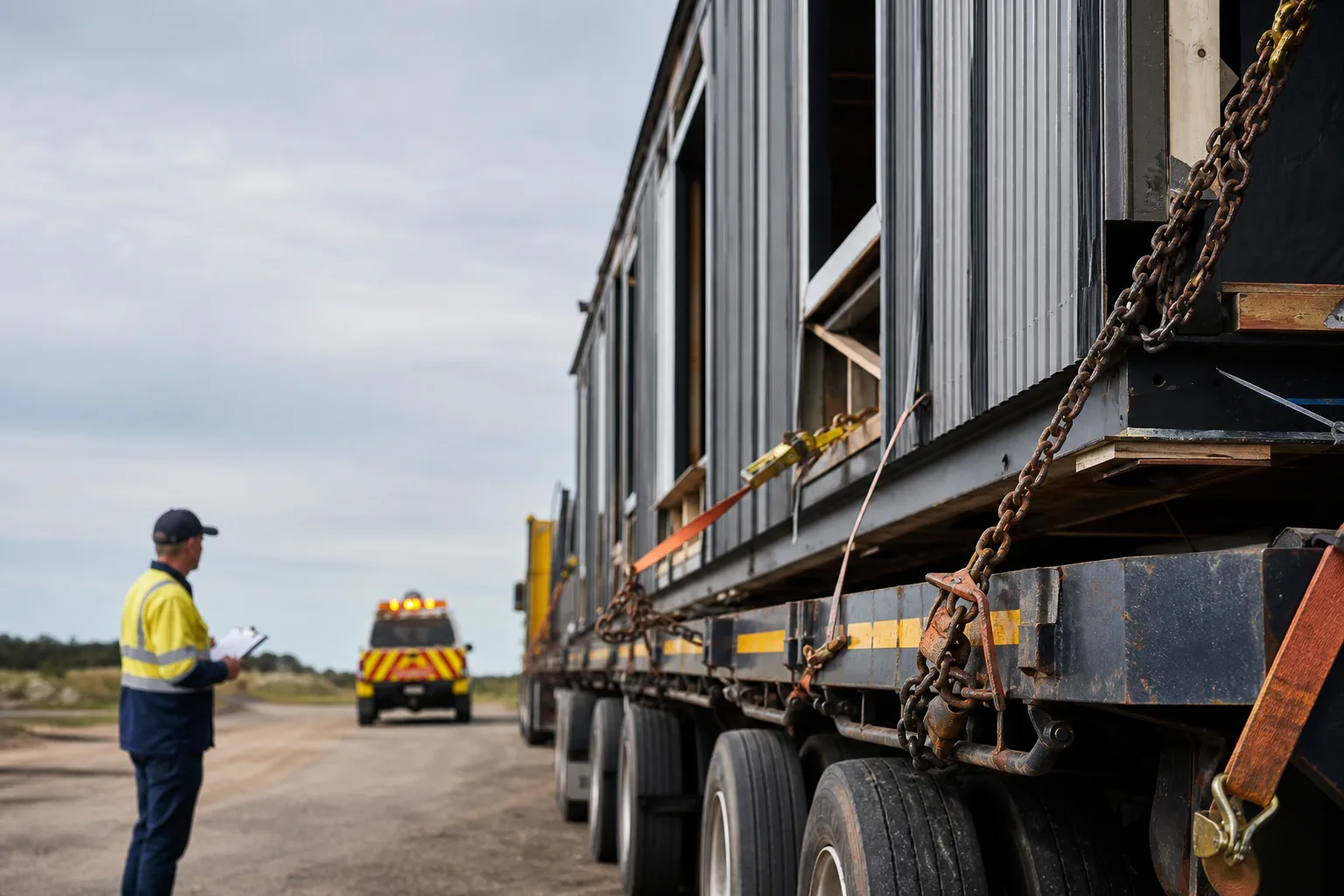
Every modular home makes a journey a site-built home never has to: from factory floor to foundation, often on an oversize load permit, sometimes across a state border. Most of these journeys go exactly to plan. This guide is for the ones that don't — what actually happens if a module is damaged in transit, who's genuinely responsible, and what to set up before delivery day so a transport problem doesn't turn into a much bigger one.
The honest starting point: liability is a contract question, not a universal rule
This is worth saying plainly, because a lot of content on this topic implies there's a single, fixed answer to "who's responsible if my module is damaged in transit." There isn't — not as a matter of a fixed Australian rule that applies to every modular project the same way. Responsibility depends on:
- 01Who arranged the transport — the manufacturer as part of a supply-and-install contract, or a haulage company engaged directly by the builder or buyer
- 02What the specific contract says about the handover point — the moment responsibility formally shifts from one party to another
- 03Whether the transport was conducted under valid permit conditions, which affects both legal compliance and how any liability dispute gets resolved
This is the same logic covered in our guide to modular partnership responsibility splits — transport is one of the specific line items that needs to be explicitly assigned in a modular contract, not assumed. If your contract doesn't clearly state who is responsible for the module between "leaves factory" and "installed on foundation," that's a gap worth closing before delivery day, not after something happens.
The regulatory backdrop: why proper permits matter beyond just legality
Modular homes routinely exceed standard road transport dimensions, which means they move under Oversize/Overmass (OSOM) permits. In most Australian states and territories, the National Heavy Vehicle Regulator (NHVR) oversees heavy vehicles over 4.5 tonnes GVM — Western Australia and the Northern Territory run their own separate systems. Even within the NHVR framework, individual states (NSW, QLD, VIC, SA and others) maintain their own specific access conditions, travel time restrictions and route approval requirements on top of the national framework.
Why this matters for a damage scenario, not just for getting the permit in the first place: an unpermitted or non-compliant oversize load that causes damage — to the module itself, to public infrastructure, or in a traffic incident — creates a liability exposure that is significantly harder to resolve cleanly than a properly permitted move. Permit conditions typically specify approved routes, escort/pilot vehicle requirements for larger loads, and sometimes restricted travel times (commonly daylight hours in built-up areas). A transport company operating outside those conditions isn't just risking a fine — they're weakening their own position, and yours, if something goes wrong.
Practical implication: before delivery day, confirm the transport operator holds the correct OSOM permit for your specific load and route, not a generic permit that may not cover your actual dimensions or path. This is a reasonable thing to ask to see evidence of, not an unusual request.
What actually causes transit damage, in practice
Based on how oversize freight transport is generally managed in Australia, the realistic risk points are:
- 01Inadequate restraint/lashing — insufficient chains, web lashings, blocking or bracing for the module's specific weight and tie-down points can allow movement during transit, which is both a damage risk and, if the cargo shifts, a potential cause of a broader incident
- 02Route hazards not properly identified in planning — overhead obstructions (power lines, traffic signals, bridge clearances) or bridge weight restrictions that weren't fully accounted for in route planning
- 03Handling at load/unload points — the lift on and off the transport vehicle is a higher-risk moment than the road transit itself for many structural issues, since it involves concentrated stress on specific structural points
None of these are unique to any one supplier — they're inherent to moving a large, heavy, factory-built structure by road, which is exactly why proper route planning and permit compliance matter as much as the quality of the module itself.
What to actually do if damage occurs
- Step 01Document everything immediately, before anything is moved further or "fixed" informally. Photos from multiple angles, of the specific damage and its location on the structure, before any cleanup or temporary repair. This is the single most important practical step, and the easiest one to get wrong in the stress of the moment.
- Step 01Identify exactly where in the transport process the damage occurred, and who had responsibility for that segment. This connects directly back to the contract question above — if the damage happened during loading at the factory, in transit, or during unloading/placement on site, different parties may have had responsibility for that specific segment depending on your contract structure.
- Step 01Notify all relevant parties promptly — the manufacturer, the transport operator, and your insurer (or broker) — rather than waiting to see how it plays out. As covered in our modular home insurance guide, transit-specific coverage is often a distinct endorsement rather than an automatic inclusion in a standard course-of-construction policy — confirm what's actually covered before you need to make a claim, and notify your insurer promptly once you do.
- Step 01Don't assume the damage disqualifies the module from use — depending on severity and location, factory-built structural elements are often repairable to full compliance standard, particularly given the engineered, documented nature of a genuine Class 1a module's construction. This should be assessed by a qualified structural engineer or the certifier involved in your project, not assumed either way without inspection.
- Step 01Keep the compliance chain intact. If the damaged module has already received structural certification, any repair needs to be documented and, depending on the nature and extent of the damage, may need re-certification or an engineer's sign-off before the build can proceed to final approval. This is not a step to skip under time pressure — it's the difference between a fully documented, insurable, compliant home and one with a gap in its paper trail.
What to confirm before delivery day, so this section never applies to you
- Step 01Ask your supplier explicitly who is responsible for the module during transit, and get the answer in the contract, not as a verbal assurance.
- Step 02Confirm the transport operator's OSOM permit covers your actual load dimensions and specific route — not a generic permit.
- Step 03Confirm your insurance position before modules ship, per our insurance guide — specifically whether transit is included in your course-of-construction policy or needs a separate endorsement.
- Step 04Confirm the handover point in writing — the exact moment responsibility shifts from transport/supplier to site/builder, so there's no ambiguity if something happens right at that boundary.
- Step 05Ask what happens procedurally if damage occurs — does your contract specify a process (notification timeframes, inspection requirements, repair-versus-replace criteria), or is this genuinely undefined? An undefined process is a gap worth closing before delivery, not discovering during a dispute.
Frequently asked questions
Who is responsible if a modular home is damaged during transport in Australia?
There is no single, universal answer — responsibility depends on the specific contract, including who arranged the transport, what the agreed handover point is, and whether the transport was conducted under valid, compliant permit conditions. This should be explicitly addressed in your supply/partnership contract before delivery, not assumed.
Does my insurance cover a modular home while it's being transported?
Not automatically, in most cases. Standard home insurance typically doesn't extend to a structure in transit. Cover during this phase generally comes from a course-of-construction (builders risk) policy, and transit-specific coverage sometimes requires a separate endorsement rather than being automatically included. Confirm this explicitly before modules ship.
What permits are required to transport a modular home in Australia?
Modular homes typically exceed standard road transport dimensions and require an Oversize/Overmass (OSOM) permit. In most states and territories, the National Heavy Vehicle Regulator (NHVR) oversees this for heavy vehicles over 4.5 tonnes GVM, though Western Australia and the Northern Territory operate their own separate systems, and individual states maintain additional access and route conditions.
If a module is damaged, does it have to be replaced entirely?
Not necessarily. Depending on the severity and location of the damage, factory-built structural elements can often be repaired to full compliance standard. This should be assessed by a qualified structural engineer or your project's certifier, and any repair should be properly documented — and potentially re-certified — to keep the compliance chain intact for final approval.
What should I do immediately if I find out my modular home was damaged in transit?
Document the damage thoroughly with photos before anything is moved or informally repaired, identify which segment of the transport process the damage occurred in, and notify the manufacturer, transport operator and your insurer promptly rather than waiting to assess the full picture first.
The bottom line
A transport problem doesn't have to become a project disaster — but only if the groundwork is in place before delivery day, not improvised afterward. Confirm who's responsible for the module in transit, confirm your transport operator's permits actually match your load and route, confirm your insurance position, and get the handover point in writing. If something does go wrong, document immediately, notify everyone promptly, and don't assume damage disqualifies a module without a proper engineering assessment. Most of what makes this stressful in practice is ambiguity that could have been resolved in the contract weeks earlier.
ModuHaus manages delivery and installation as part of a documented process, with compliance and structural certification carried through from factory to final handover — see our delivery and access checklist for what to prepare on your end before delivery day.
**Start your Planning Assessment →**
This article is general information only and not legal, insurance or engineering advice. Liability, contractual responsibility and compliance requirements vary by project, contract terms and jurisdiction. Always confirm current requirements and your specific contractual position with your supplier, insurer, and a qualified engineer or certifier before making project decisions.
Last updated: 20/08/2026. Verified against NHVR-related regulatory sources and cross-referenced with ModuHaus's existing insurance and responsibility-split guidance on 20/08/2026.
Sources and further reading
Requirements change and can be applied differently by site and local authority. Check the current official sources and confirm your project with the relevant council, certifier or qualified professional.