
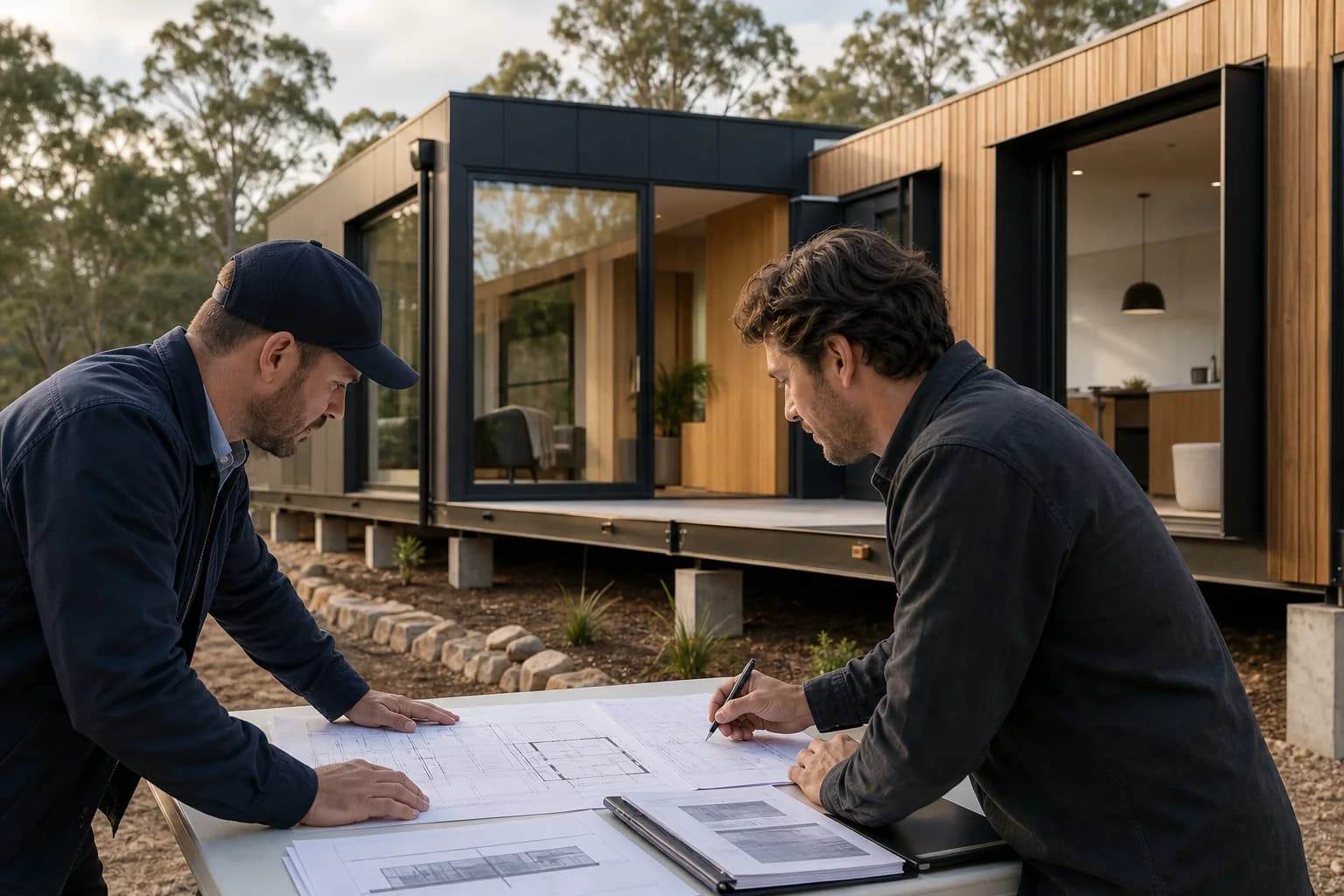
The question that ends most builder-manufacturer conversations before they start isn't "does modular work" — it's "if something goes wrong, whose problem is it." That's a fair question, and a vague answer is a legitimate reason to walk away. This article sets out, plainly, where responsibility typically sits in a builder-manufacturer modular partnership, across design, approval, site works, and what happens after handover — so you can go into a partnership conversation asking sharper questions, not just hoping the contract covers it.
Why this needs to be explicit, not assumed
In a conventional site build, responsibility is relatively well understood — the builder holds the licence, manages the trades, and carries the liability chain end to end. A modular partnership splits that chain across two businesses: a manufacturer producing a factory-built, certified product, and a builder or developer managing land, sales, approval and site delivery. That split is exactly what makes the model efficient — neither party is trying to do the other's job — but it only works cleanly if the split is documented, not assumed.
The responsibility table below reflects how a well-structured partnership typically divides these functions. Every point should be confirmed and documented in your specific partnership agreement — this is a framework for the conversation, not a substitute for the contract.
The responsibility split, function by function
| Function | Typically the manufacturer's responsibility | Typically the builder/developer's responsibility |
|---|---|---|
| Product design | The standardised design range, structural engineering, and any manufacturer-approved customisation options | Selecting the product and configuration to match the specific site and buyer |
| Structural certification | Structural engineering certification (AS 4055, AS/NZS 1170.2, AS 1170.4) for the product design | Ensuring site-specific engineering (foundations, wind/BAL rating) reflects the actual site conditions |
| Planning approval (DA/CDC) | Providing product drawings and compliance documentation needed to support an application | Lodging and managing the DA/CDC process with council, engaging any required specialist reports |
| Building approval & certification | Manufacturer certification for the factory-built structure | Coordinating the building surveyor/certifier for the complete installed home, including site-specific elements |
| Foundations & site works | Installation manual and specifications for the foundation interface | Foundation construction, site preparation, and ensuring it meets the manufacturer's specification |
| Delivery & installation | Transport, delivery and installation of the modular structure, per the agreed scope | Site access preparation, coordinating delivery timing, any required permits for oversized transport |
| Service connections | — | Plumbing, electrical and other trade connections to mains/site services, by licensed local trades |
| Sales & customer relationship | — | The buyer relationship, sales process, pricing, and finance conversations |
| Structural defects (factory-related) | Manufacturer warranty covers defects in the factory-built structure and its certified components | Reporting and coordinating the claim on behalf of the customer |
| Site-related defects | — | Defects arising from foundations, site works, or trade connections managed by the builder |
| Ongoing customer relationship post-handover | Manufacturer support for product-related warranty claims | Primary point of contact for the customer; the builder's brand relationship continues |
The three areas that need the most explicit agreement
Three specific points cause the most friction if left vague — worth resolving explicitly in any partnership agreement, not left to be worked out later:
1. Where does "design" end and "customisation" begin? A manufacturer's standardised range keeps costs and certification predictable. Requests that go meaningfully beyond that range — a layout change, a structural modification — need a clear process: is it possible, who re-certifies it, and who bears the cost and timeline impact? Agree this mechanism upfront, not project by project under time pressure.
2. Who owns a defect that could be either factory or site-related? Some defects are unambiguous — a factory-installed fixture failing is clearly a product issue; a foundation settling unevenly is clearly a site issue. Others are genuinely ambiguous — a door not closing properly could stem from either. A good partnership agreement defines an inspection and attribution process for exactly this scenario, rather than leaving it to be negotiated after a customer complaint has already arrived.
3. Who's the customer's primary point of contact, always? Even where the manufacturer's warranty covers a specific defect, the customer relationship usually needs to stay with the builder — that's who sold them the home and who they trust. The mechanism for the builder to escalate a manufacturer warranty claim on the customer's behalf, without the customer needing to manage two relationships, should be explicit and fast.
What good documentation looks like
Before any project proceeds, a genuine partnership should have documented:
- 01A defined scope of supply — precisely what the manufacturer delivers (product, engineering, certification, delivery, installation) versus what the builder delivers
- 02A warranty structure — what's covered by manufacturer warranty, what's covered by the builder's own warranty obligations (including statutory home warranty insurance requirements in your state), and how a claim is lodged and processed
- 03An inspection and test plan (ITP) — the checkpoints at which each party signs off on their portion of the work
- 04A defects liability process — a clear, agreed method for attributing and resolving defects that could plausibly sit with either party
- 05A change process — how customisation requests are assessed, priced and re-certified if needed
What this means for your existing licensing and insurance
A modular partnership doesn't remove your obligations as the licensed builder for a project — in most cases, you retain your normal builder licensing and statutory home warranty insurance obligations for the parts of the project you're responsible for delivering. What changes is the scope those obligations apply to: your site works, approvals and the completed project, rather than every stage of construction. Confirm directly with your insurer and licensing body how a modular partnership affects your specific coverage — this varies by state and by the structure of the specific agreement, and is worth resolving before your first project, not during it.
Questions to ask before signing a partnership agreement
- Step 01"Can I see a sample scope-of-supply document from a completed project?" — a manufacturer with real partnership experience should have one.
- Step 02"What's the process if a defect's cause is disputed between us?" — get the mechanism, not just the assurance.
- Step 03"What happens if I want to customise beyond the standard range?" — ask for the actual process and cost/timeline impact, not a general "yes, that's possible."
- Step 04"How does your warranty interact with my state's statutory home warranty insurance requirements?" — this needs a specific, not general, answer for your state.
- Step 05"Who's the customer's contact if something goes wrong after handover — and how fast does a manufacturer claim get escalated?"
Frequently asked questions
Who is responsible for defects in a modular home built through a builder-manufacturer partnership?
It depends on the source of the defect. Manufacturer warranty typically covers defects in the factory-built structure and its certified components. The builder is typically responsible for defects arising from foundations, site works, or local trade connections. A well-documented partnership agreement defines an inspection and attribution process for cases where the source isn't immediately clear.
Who lodges the DA or CDC application for a modular home project?
Typically the builder or developer, since they hold the local council relationship and manage the site-specific planning context. The manufacturer usually provides the product drawings and compliance documentation needed to support the application, but doesn't lodge it directly.
Does a builder need their own licence and insurance to sell modular homes?
Generally yes — a modular partnership doesn't remove a builder's normal licensing and statutory home warranty insurance obligations for the parts of the project they deliver. It changes the scope those obligations apply to, since factory-built product responsibility sits with the manufacturer. Confirm the specific interaction with your insurer and licensing body for your state.
Can a builder request custom design changes to a modular product?
Often yes, within limits, but this should have a clearly defined process agreed upfront — including who re-certifies the change, and the cost and timeline impact. Requests that go meaningfully beyond a manufacturer's standardised range can affect certification and pricing significantly, so this shouldn't be negotiated informally on a per-project basis.
Who manages the customer relationship after handover?
Typically the builder remains the customer's primary point of contact, since they hold the sales relationship. Where a defect falls under manufacturer warranty, the builder generally escalates the claim on the customer's behalf, so the customer doesn't need to manage two separate relationships directly.
The bottom line
A modular partnership works because it splits responsibility along genuine lines of expertise — product and certification with the manufacturer, land and delivery with the builder. But that split only holds up if it's written down clearly before the first project starts, particularly around customisation, defect attribution, and how manufacturer warranty interacts with your own licensing and insurance obligations. A manufacturer that can answer these questions specifically, with real documentation, is a genuinely different proposition to one that answers them with general reassurance.
ModuHaus works from a documented scope of supply and warranty structure with every builder partner, covering exactly the areas set out above. Read the companion piece on adding modular to your House & Land range for how the partnership itself comes together.
**Discuss a Builder Partnership →**
This article is general business information, not legal, insurance or licensing advice. Builder licensing, statutory warranty insurance requirements and contractual arrangements vary by state and by the specific partnership agreement. Always confirm your obligations with your licensing body, insurer and legal adviser before entering a partnership agreement.
Last updated: 23/07/2026.
Sources and further reading
Requirements change and can be applied differently by site and local authority. Check the current official sources and confirm your project with the relevant council, certifier or qualified professional.