
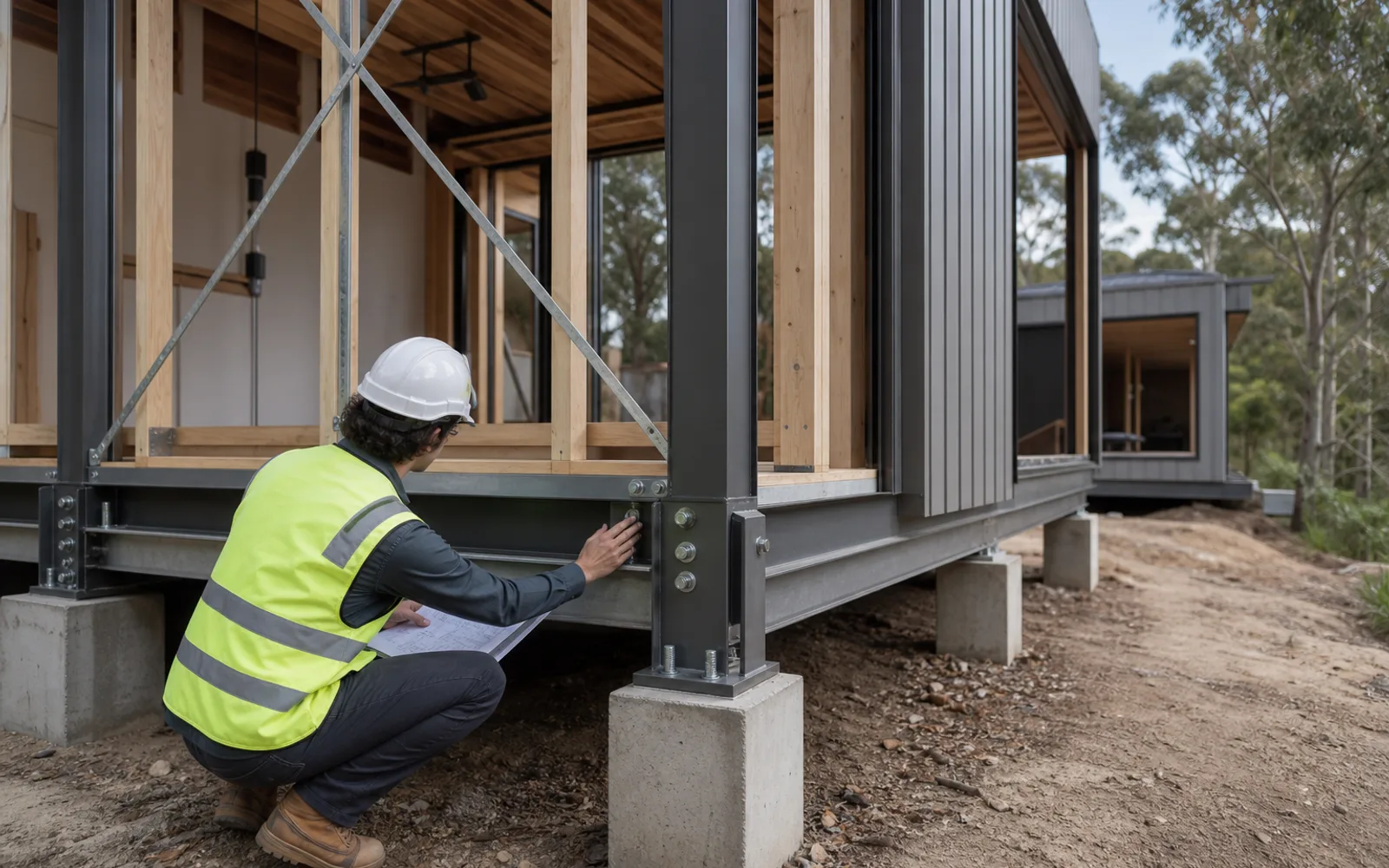
The most common question about modular homes isn't about design or price — it's whether the structure itself is actually as strong as a conventional house. It's a fair question, and it deserves a specific answer, not a marketing one. The answer is this: a permanent, Class 1a modular home is engineered to the exact same Australian structural standards as a site-built house — not a modular-specific version, not a relaxed version. The same wind standard, the same earthquake standard, assessed against the same National Construction Code. This article walks through what those standards actually require, in plain language, so you can see for yourself where the compliance line sits.
The standard that matters most for houses: AS 4055
Most Australian houses — including permanent modular homes — are engineered against AS 4055: Wind Loads for Housing. This is the primary wind standard referenced by the National Construction Code, and it applies specifically to NCC Class 1 (houses) and Class 10a buildings, within defined geometric limits (height, width, roof pitch and similar).
AS 4055 works by assigning a wind speed classification — commonly seen as ratings like N1 to N6 for non-cyclonic regions and C1 to C4 for cyclonic regions — based on your site's wind region, terrain, shielding and topography. The higher the classification, the stronger the structure, tie-downs, cladding fixings and connections need to be engineered.
The point that matters: this classification is applied to your site, not your construction method. A modular home on an N3-rated coastal block and a site-built home on the same block are engineered to the same N3 requirements under the same standard. There is no separate, lower classification system for modular or prefabricated homes.
Where a house falls outside AS 4055's geometric limits — larger or more complex designs — the fallback is the broader AS/NZS 1170.2: Wind Actions standard, again applying equally regardless of construction method.
What about earthquake risk?
Australia is a comparatively low-seismicity country, but the NCC's Deemed-to-Satisfy provisions still require compliance with AS 1170.4: Structural Design Actions — Earthquake Actions. This standard sets out how buildings, including their non-structural components such as internal linings and fixtures, need to be designed to withstand seismic loads appropriate to their location.
As with wind, earthquake compliance is assessed against the building's classification and location — not its construction method. A Class 1a modular home is required to meet the same AS 1170.4 provisions as a Class 1a site-built home in the same location.
So does "modular" mean a different rulebook? No.
This is the part worth being direct about, because it's where a lot of scepticism about modular homes comes from. The assumption is often that a factory-built home must be following some kind of separate, lighter-weight standard — the structural equivalent of a "budget" specification.
It isn't. Under the National Construction Code, a building's classification (Class 1a, in this case) determines which standards apply — not whether it was built on-site or in a factory. AS 4055, AS/NZS 1170.2 and AS 1170.4 all apply to Class 1a buildings as a category. A permanent modular home has to pass the same engineering bar as a conventional build, assessed by the same category of structural engineer, certified by the same category of building surveyor, under the same code.
Where modular differs is how that compliance is achieved — engineered panels, factory-controlled connections and pre-certified designs, rather than progressive on-site framing — not what it's required to achieve.
What "engineered to the same standard" actually means in practice
For a buyer, this translates into a few concrete things worth checking:
- 01Your specific site gets its own wind classification. A supplier should be assessing your site's wind region, terrain category and any shielding or topographic exposure — not applying a generic, one-size-fits-all rating.
- 02The engineering certificate should reference the specific standards. Ask to see documentation that names AS 4055 (or AS/NZS 1170.2, for larger designs) and AS 1170.4 explicitly, tied to your site's classification.
- 03Connections and tie-downs matter as much as the panels. Wind engineering for houses is as much about how the structure is fixed to its foundations and how sections connect to each other as it is about wall strength — this is a specific area to ask a modular supplier about, since the home is assembled from delivered sections.
- 04Higher-risk sites need higher-rated engineering, regardless of construction method. A coastal, cyclonic-region or exposed rural site will require a higher wind classification whether you build modular or conventionally — this is a site cost, not a modular cost.
Common misconceptions, addressed directly
"Modular homes are lighter, so they must be weaker." Weight isn't the same as strength. Structural adequacy is assessed against engineered load paths and connections, not gross weight. A well-engineered lighter structure can meet the same wind and seismic requirements as a heavier one — that's precisely what the standards are designed to verify, regardless of material or method.
"You can't really engineer for cyclones in a factory." Cyclonic wind classifications (C1–C4 under AS 4055) apply to any house in a cyclonic region, modular or site-built. Factory-built modular homes are engineered and certified for cyclonic regions in exactly the same way — the standard doesn't distinguish by construction method.
"There's no way to verify this — I just have to trust the supplier." You don't have to take it on trust. Ask for the structural engineering certification, with the specific standards and your site's wind/seismic classification named on it. A supplier with a genuine Class 1a compliance process will have this documentation ready — see our guide on how a modular home is certified for the full certification chain.
Frequently asked questions
Are modular homes built to the same standards as normal houses?
Yes. A permanent, Class 1a modular home is engineered to the same National Construction Code requirements as a site-built house, including AS 4055 (Wind Loads for Housing) or AS/NZS 1170.2 (Wind Actions) and AS 1170.4 (Earthquake Actions). These standards apply based on the building's classification and site conditions, not its construction method.
What wind rating do modular homes have?
The wind rating depends on the specific site, not on whether the home is modular. Under AS 4055, sites are classified from N1 to N6 (non-cyclonic) or C1 to C4 (cyclonic) based on wind region, terrain and exposure. A modular home on a given site is engineered to the same classification a site-built home on that site would require.
Can modular homes withstand cyclones?
Yes, when engineered to the appropriate cyclonic classification (C1–C4) under AS 4055, in the same way any house in a cyclonic region must be. Cyclonic engineering requirements apply based on the site's wind region under the National Construction Code, regardless of whether the home is modular or site-built.
Are modular homes earthquake-proof?
No home is "earthquake-proof," but a permanent Class 1a modular home is required to meet the same AS 1170.4 (Earthquake Actions) requirements as any other house under the National Construction Code's Deemed-to-Satisfy provisions. This applies equally regardless of construction method.
How do I know a modular home actually meets these standards?
Ask for the structural engineering certification for your specific home and site, with the applicable standards (AS 4055, AS/NZS 1170.2, AS 1170.4) and your site's wind/seismic classification stated explicitly. This should be part of the certification documentation, not just a verbal assurance — see our guide to the Class 1a certification process for what a genuine compliance pathway includes.
The bottom line
There's no separate, lower structural bar for modular homes in Australia. A permanent Class 1a modular home is assessed against exactly the same wind and earthquake standards — AS 4055, AS/NZS 1170.2, AS 1170.4 — as a conventional house, because those standards apply by building classification and site conditions, not construction method. The honest question to ask any supplier isn't "is modular as strong as site-built?" — it's "show me the certification for my specific site." That's where the real answer lives.
Every ModuHaus permanent home is engineered to these standards for its specific site, with full documentation available through our certification process. A Planning Assessment is the place to start understanding what your site's structural requirements will be.
**Start your Planning Assessment →**
This article is general information only and not structural engineering or building advice. Standards referenced (AS 4055, AS/NZS 1170.2, AS 1170.4) are subject to periodic amendment. Always confirm current standard versions and site-specific engineering requirements with a qualified structural engineer or building certifier.
Last updated: 23/07/2026. Verified against Standards Australia, HIA and Engineers Australia sources on 23/07/2026.
Sources and further reading
Requirements change and can be applied differently by site and local authority. Check the current official sources and confirm your project with the relevant council, certifier or qualified professional.