
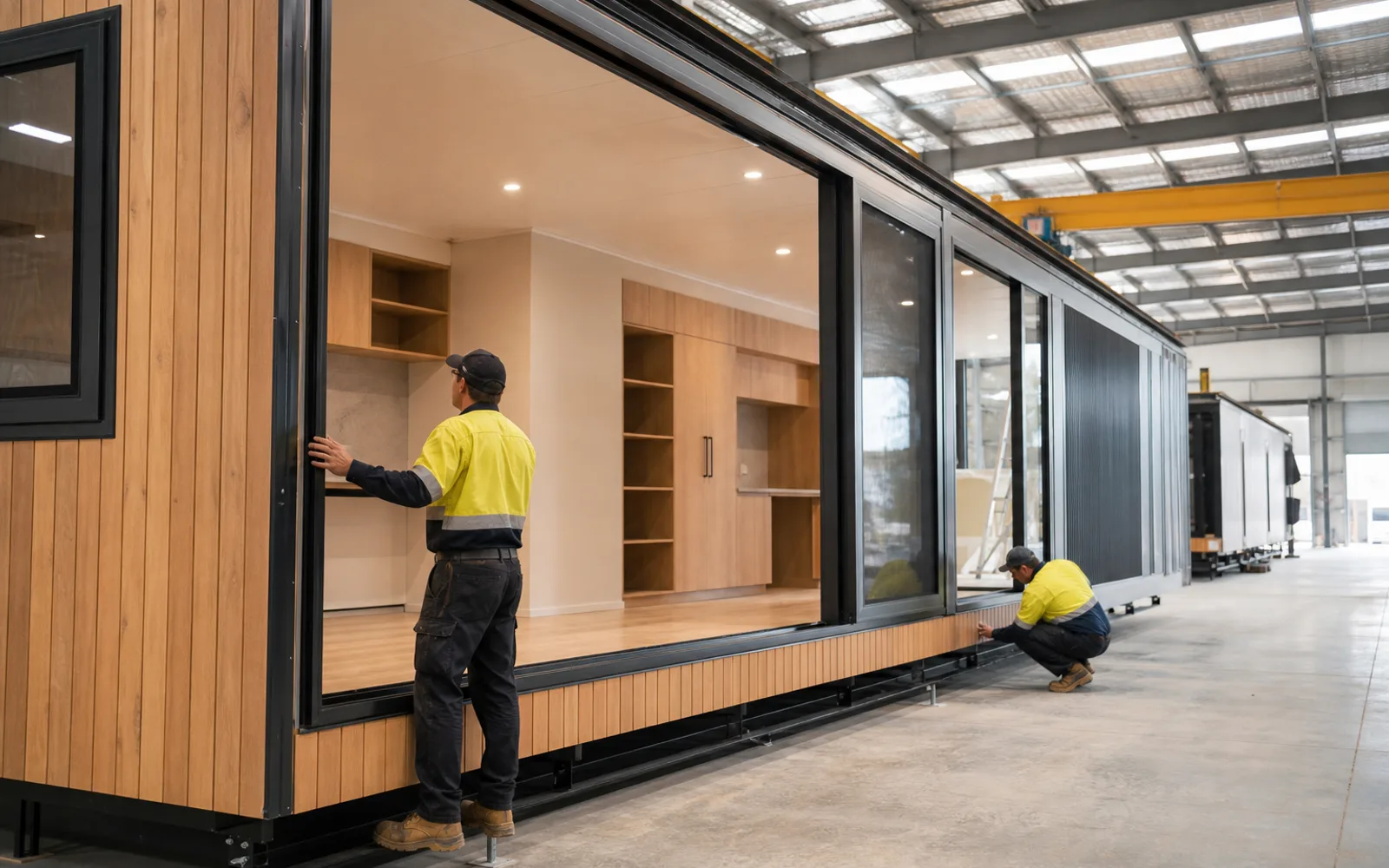
There's a natural assumption that runs through a lot of conversations about modular homes: if it's built faster, something must be getting skipped. It's an understandable instinct — in most areas of life, speed and shortcuts do travel together. But construction is one of the few areas where that instinct is often backwards. The reason a modular home builds faster isn't that steps are skipped — it's that the conditions the work happens in are controlled, instead of left to whatever the weather and the site throw at a crew that week. This article explains why factory-built speed and quality aren't in tension, and where the real quality risks in home building actually come from.
Where the speed actually comes from
It helps to be specific about what "faster" means, because the reasons aren't mysterious or corner-cutting — they're structural to how the process works.
Parallel work, not compressed work. In a site build, foundations, framing, and internal fit-out generally happen in sequence, each waiting for the last. In a modular build, site preparation and foundation work happen at the same time as the home is being manufactured in the factory. The overall project timeline shrinks because two timelines are running simultaneously — not because either one has been rushed.
No weather delays during construction. An open-air building site loses days — sometimes weeks — to rain, wind, extreme heat and other weather that halts specific trades. A factory floor doesn't have a weather forecast. The home is built in a controlled, covered environment from start to finish, which removes one of the largest sources of delay (and, as covered below, one of the largest sources of quality risk) in conventional building.
Standardised, repeatable processes. A factory building the same well-engineered design repeatedly develops tighter processes than a site crew building a one-off custom home for the first time. Repetition, in manufacturing, tends to reduce variability — it's the same principle behind why a factory-made product is generally more dimensionally consistent than a handmade one.
None of this involves skipping a structural step, a certification stage, or an inspection. It involves removing the delays and variability that have nothing to do with the standard of the finished home.
Why factory conditions can actually reduce quality risk
This is the part worth taking seriously, because it runs against the intuition. Several of the most common defects in conventional home building come specifically from on-site, weather-exposed construction — not from a lack of skill or care by the builder.
- 01Moisture ingress during construction. Timber frames and materials left exposed to rain before a roof and external cladding are in place are a well-known source of later moisture-related defects. A factory-built module is assembled under cover, with materials that aren't sitting exposed to the elements at any stage of the build.
- 02Dimensional inconsistency. Site-cut and site-measured work varies with the conditions and the individual tradesperson on a given day. Factory production uses jigs, templates and repeatable processes that reduce this kind of variation between units.
- 03Inspection access. Factory quality checks happen at defined checkpoints on a production line, where a specific stage of construction is fully accessible for inspection before the next stage begins. On an open site, some inspection points can be more time-pressured or harder to access cleanly, particularly on tight schedules.
None of this means site-built homes are poorly built — the vast majority aren't. It means the conditions that most commonly contribute to construction defects are specifically the conditions a factory build largely removes.
What doesn't change, no matter how fast the build is
It's worth being precise about this, because "faster" should never be confused with "less." A genuine, certified modular build still includes every one of the following — see our guide on the Class 1a certification process for the full detail:
- 01The same structural engineering requirements (AS 4055, AS/NZS 1170.2 and AS 1170.4 — identical standards to a site build)
- 02The same NCC energy efficiency requirements (7-star NatHERS-equivalent thermal performance)
- 03The same licensed trades for plumbing and electrical work, certified to the same Australian Standards
- 04The same building surveyor sign-off and occupation certificate process
- 05The same materials specifications — a genuine Class 1a home isn't built from a lower material grade because it's manufactured off-site
Speed comes from how the work is sequenced and where it happens — not from removing any of the compliance steps above.
The questions that actually tell you about quality
If "is it fast because it's cheap" is the real underlying question, these are more useful things to ask a supplier than the build timeline itself:
- Step 01"What inspection checkpoints happen during factory production?" — a genuine quality process has defined stages, not just a single check at the end.
- Step 02"Can I see the factory, or footage of the production process?" — a supplier confident in their process is generally willing to show it.
- Step 03"What happens on-site after delivery, and who inspects that stage?" — the site connection and installation stage still needs its own quality control, separate from the factory build.
- Step 04"What's your defect/warranty process if something is found after handover?" — a clear answer here says more than a fast build time does.
- Step 05"How long has this specific design been in production?" — a design that's been refined over multiple builds tends to have fewer unresolved issues than a brand-new one.
Frequently asked questions
Does a faster build mean lower quality for a modular home?
No, not for a genuinely certified Class 1a modular home. The speed comes from site preparation and factory manufacturing happening in parallel, and from the factory environment removing weather delays — not from skipping structural, certification or inspection steps, which remain identical to a site-built home.
Why are modular homes built faster than site-built homes?
Two main reasons: site works and factory manufacturing happen simultaneously rather than in sequence, and factory construction isn't exposed to weather delays that commonly slow open-air building sites. Standardised, repeated production processes also tend to be more efficient than one-off custom site builds.
Can factory conditions actually improve quality compared to a site build?
In some respects, yes. Several common building defects — moisture ingress during construction, dimensional inconsistency, and inspection access issues — are specifically associated with open-air, weather-exposed site conditions. A controlled factory environment reduces exposure to these particular risks, though overall quality still depends on the specific manufacturer's processes and standards.
Do modular homes skip any building standards to build faster?
No. A genuine permanent Class 1a modular home meets the same structural (AS 4055, AS 1170.4), energy efficiency (NatHERS/NCC 2022) and certification requirements as a site-built home. Speed comes from how and where construction happens, not from removing compliance steps.
How can I check the quality of a specific modular home supplier?
Ask about their factory inspection checkpoints, whether you can see the factory or production footage, how the post-delivery site connection is inspected, and their defect and warranty process. These questions reveal more about actual build quality than the headline construction timeline.
The bottom line
The instinct that "fast must mean cut corners" makes sense in general life, but it doesn't hold up against how modular construction actually works. The speed comes from parallel timelines and weather-free factory conditions — not from skipped steps. If anything, some of the most common defects in conventional building are specifically tied to the open-air, sequential conditions that a factory build removes. The real test of quality isn't how long a build takes — it's whether the structural standards, certification chain and inspection process are genuine, which is a question worth asking directly rather than assuming from the timeline alone.
Every ModuHaus permanent home follows the full Class 1a certification chain regardless of build speed — the same standards, the same inspections, delivered through a faster, weather-controlled process. A Planning Assessment is the place to see how that applies to your project.
**Start your Planning Assessment →**
This article is general information only and not building or engineering advice. Quality and inspection processes vary between suppliers and manufacturers. Always confirm a specific supplier's certification, inspection and warranty processes directly before purchasing.
Last updated: 23/07/2026.
Sources and further reading
Requirements change and can be applied differently by site and local authority. Check the current official sources and confirm your project with the relevant council, certifier or qualified professional.