
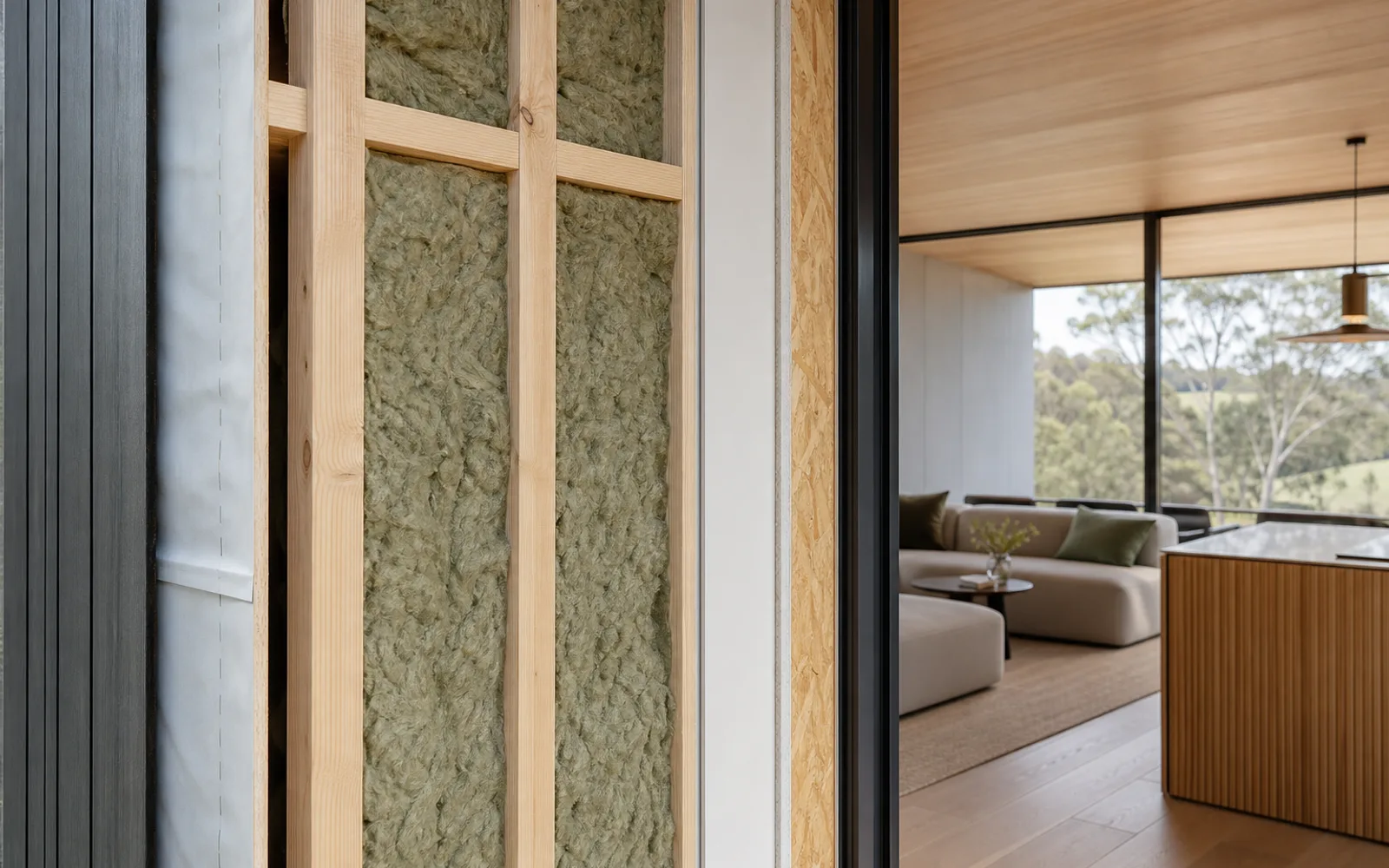
When people compare modular and traditional (site-built) homes, three questions come up more than any others: will it be as warm or cool, will it be as quiet, and will it last as long? These are fair, practical questions — and the honest answer is that for a permanent, certified Class 1a modular home, the comparison is closer than most people expect, because both are assessed against the same National Construction Code requirements. This article lays out the comparison directly, category by category, with the standards behind each one.
The comparison at a glance
| Category | Modular (Class 1a) | Traditional site-built |
|---|---|---|
| Governing standard | NCC 2022 — 7-star NatHERS-equivalent + Whole-of-Home energy budget | Identical: NCC 2022 — 7-star NatHERS-equivalent + Whole-of-Home energy budget |
| Structural standard | AS 4055 / AS/NZS 1170.2, AS 1170.4 | Identical: AS 4055 / AS/NZS 1170.2, AS 1170.4 |
| Insulation approach | Factory-installed in controlled conditions; consistent placement and coverage | Site-installed; coverage and installation quality varies by trade and conditions on the day |
| Thermal performance basis | NatHERS star rating assessed per design, same as any home | NatHERS star rating assessed per design, same as any home |
| Acoustic performance | Depends on wall/floor specification and manufacturer — no universal advantage either way | Depends on wall/floor specification and builder — no universal advantage either way |
| Weather exposure during construction | None — built under cover in a factory | Framing and materials often exposed to weather before lock-up |
| Dimensional consistency | High — jig- and template-based factory production | Varies by site conditions and tradesperson |
| Expected lifespan (permanent, certified) | Comparable to site-built — same materials durability standards apply | Comparable to modular — same materials durability standards apply |
| Maintenance requirements | Standard home maintenance, comparable to any house | Standard home maintenance, comparable to any house |
The pattern in this table matters more than any single row: on every point governed by an Australian Standard or the NCC, the requirement is identical. The genuine differences are in how each requirement is met, not in what's required.
Insulation and thermal performance
Since NCC 2022, every new Class 1a home — modular or site-built — must meet a 7-star NatHERS-equivalent thermal performance rating, plus a Whole-of-Home energy budget covering fixed appliances such as heating, cooling and hot water systems. This has been progressively adopted across most states and territories, with some state-specific variation in timing (see our Class 1a guide for the detail).
This means the target is identical for both construction methods. Where they can differ is in how consistently that target is achieved:
- 01Modular: insulation is installed in a factory under controlled conditions, with less variation from unit to unit. Gaps or compression in insulation — a common real-world cause of underperforming thermal ratings, even in a "compliant" design — are easier to control on a production line with repeatable processes.
- 02Site-built: insulation quality depends on the individual installer, the weather and site conditions on the day, and how carefully gaps around services, junctions and penetrations are sealed. A well-supervised site build can match factory consistency; a rushed one is more prone to installation gaps.
The honest takeaway: the design rating is the same requirement either way. The as-built performance — how closely the finished home matches its design rating — depends more on installation quality and supervision than on construction method, though factory conditions make consistent installation easier to control.
Acoustic performance
This is the category where the comparison is most genuinely case-by-case, and it's worth being straightforward about that rather than overselling a blanket answer either way.
Acoustic performance in a home comes down to the specific wall, floor and ceiling construction — insulation type, stud/frame configuration, layers of lining, and sealing around junctions — not the broad category of "modular" or "site-built." A well-specified modular home with proper acoustic insulation and sealed junctions performs comparably to a well-built site home with the same specification. A poorly sealed or under-specified build in either category can underperform.
For attached dwellings (townhouses, duplexes, multi-unit modular arrangements), NCC acoustic separation requirements between dwellings apply under Volume Two regardless of construction method — the same compliance obligation exists either way.
The practical question to ask a modular supplier isn't "is modular quieter or louder than site-built" — it's "what's the wall and floor specification, and what acoustic treatment does it include," which is exactly what you'd ask a conventional builder too.
Durability
For a permanent, Class 1a certified modular home, durability expectations are set by the same materials standards and structural requirements as a site-built home — because it's the same classification, assessed against the same code.
The factors that most affect a home's long-term durability apply equally to both:
- 01Material quality and specification — cladding, roofing and structural materials rated for the local climate and exposure
- 02Moisture management — detailing around junctions, flashing and weatherproofing
- 03Maintenance over time — no home, modular or site-built, is maintenance-free
- 04Site conditions — exposure to coastal salt air, bushfire-prone vegetation, or extreme UV affects any home's materials over time, regardless of construction method
Where modular can have a genuine, specific advantage is during the construction phase itself: materials aren't exposed to weather while the home is being built, which removes one common source of latent moisture-related defects that can affect long-term durability in a conventional build (see our companion article on build speed and quality for more on this).
What this comparison doesn't tell you
It's worth being direct about the limits of a general comparison like this: individual supplier and builder quality matters more than the modular-vs-traditional category. A high-quality modular manufacturer with proper factory QC will outperform a poorly-run site build, and a skilled, well-supervised site builder will outperform a low-quality modular supplier cutting corners on specification. The category doesn't guarantee the outcome — the specific supplier's standards do.
This is why every comparison in this article keeps returning to the same practical advice: ask for the specific standards, ratings and specifications for the home you're considering, rather than relying on a general assumption about modular or traditional construction.
Frequently asked questions
Is a modular home as well insulated as a traditional home?
Both are required to meet the same NCC 2022 thermal performance standard — a 7-star NatHERS-equivalent rating plus a Whole-of-Home energy budget. The design target is identical. Factory installation can offer more consistent as-built insulation coverage than site installation, though a well-supervised site build can match it.
Are modular homes quieter or louder than traditional homes?
Neither has a universal advantage — acoustic performance depends on the specific wall, floor and ceiling specification, not the broad construction category. A well-specified modular home performs comparably to a well-built site home with the same acoustic treatment. Ask about the specific wall/floor specification for any home you're considering.
Do modular homes last as long as traditional homes?
A permanent, Class 1a certified modular home is built to the same materials and durability standards as a site-built house, since both are assessed against the same classification and code. Lifespan depends more on material quality, moisture management and maintenance than on construction method.
What's the R-value of a modular home?
There's no single fixed R-value — it depends on the specific design and its NatHERS rating, the same as any home. Since NCC 2022, new homes generally need to meet a 7-star NatHERS-equivalent thermal performance standard, which modular and site-built homes are both required to achieve.
Does weather exposure during construction affect quality?
Yes, and this is one area where modular construction has a specific, genuine advantage — materials aren't exposed to weather during a factory build, which removes a common source of moisture-related defects that can affect conventional site builds exposed to rain before lock-up.
The bottom line
On paper, the comparison between modular and traditional construction isn't really modular-versus-traditional at all — it's a comparison against the same NCC and Australian Standards requirements either way. The real variation is in execution: how consistently insulation is installed, how well acoustic junctions are sealed, how carefully materials are protected during construction. Modular's factory conditions offer some genuine, specific advantages — particularly around weather exposure and installation consistency — but the deciding factor for any individual home is the specific supplier's standards, not the general category it falls into.
Every ModuHaus permanent home is built to the same NCC 2022 thermal and structural standards, with full specification documentation available for review. A Planning Assessment is the place to see exactly what applies to your project.
**Start your Planning Assessment →**
This article is general information only and not engineering, building or acoustic consulting advice. Specific performance depends on the individual home's design, specification and construction quality. Always request specific ratings, specifications and certification for any home you are considering, whether modular or site-built.
Last updated: 23/07/2026. Verified against NCC 2022 energy provisions on 23/07/2026.
Sources and further reading
Requirements change and can be applied differently by site and local authority. Check the current official sources and confirm your project with the relevant council, certifier or qualified professional.