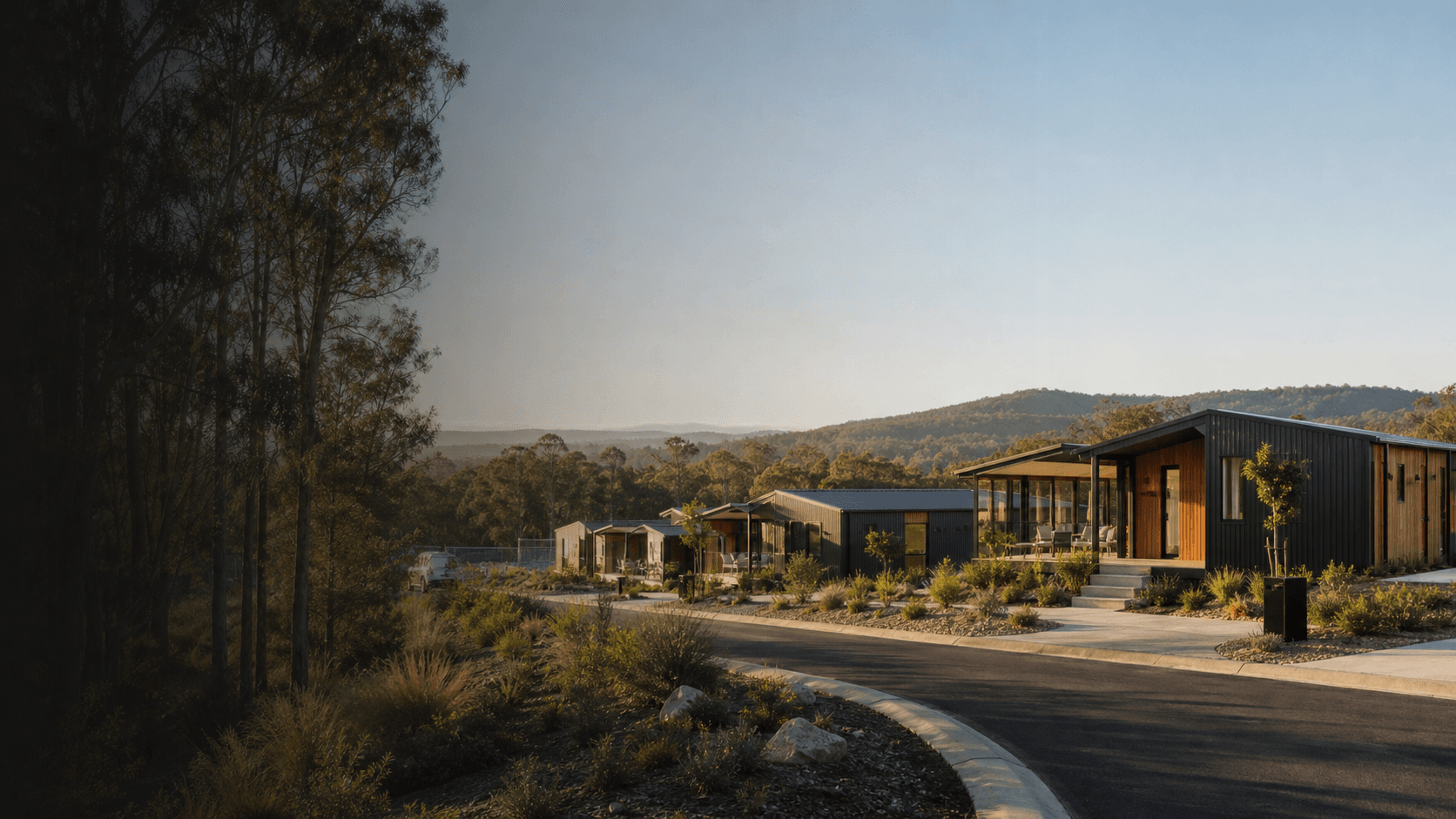
A modular housing development set among Australian native trees.

For builders and developers

Class 1A Modular Homes for Builders and Developers

Add a considered factory-built product pathway to your residential, regional or secondary-dwelling pipeline. ModuHaus helps connect the early brief, product fit, supplier pathway and site conversation.

Developer pathway, in brief

From early feasibility to a coordinated handover.

The commercial value of modular delivery depends on clear evidence, interfaces and responsibilities across both the factory and the site.

Answer 01

Where should a developer or builder begin?

A developer or builder should begin with the site, intended use, target resident, repeatability requirements, planning context, delivery access and a written responsibility split. That evidence becomes the project brief used to test product and supplier fit before anyone promises a final price, programme, approval outcome or delivery date.

Answer 02

What is the path from feasibility to delivery?

Define the brief, test site and approval constraints, shortlist the product pathway, allocate design and delivery responsibilities, confirm documentation and commercial scope, prepare the site, then coordinate manufacture, transport, installation and handover.

Review the developer project process

Answer 03

What can be assessed before supplier appointment?

The team can assess intended use, preliminary product fit, site and access constraints, likely consultant needs, delivery interfaces and the questions a responsibility matrix must resolve.

Answer 04

What must be confirmed in writing?

The appointed parties must confirm current drawings, inclusions, engineering and certification evidence, manufacture and payment terms, transport dimensions, warranties, programme, final price and responsibility for approvals, site work, installation and defects.

No certification status, warranty period, delivery date or final project price is implied by the product catalogue.

Last reviewed

8 September 2026

Publisher and reviewer

ModuHaus Editorial Team

Sources and scope

The pathway describes coordination principles only. Project contracts, appointed professionals and current supplier documents determine the actual scope and responsibilities.

A practical delivery pathway

More certainty before site work begins.

Factory-built construction can give a project team a clearer product scope early, while retaining the local expertise needed for siting, approvals, services, access and delivery.

Class 1A

Residential classification is only one part of the pathway. The intended use, site, planning controls, engineering, certification and delivery scope all need to be resolved for the individual project.

Read the Class 1A guide Compare permanent modular homes

Why builders are considering modular

A product pathway for constrained labour, regional demand and repeatable work.

The value is not simply speed. It is the ability to align a defined factory product with a disciplined local site and approvals process.

01

Defined product

A clearer early scope can make feasibility, estimating and client conversations more concrete.

02

Protected manufacture

Much of the build can progress in a controlled factory environment while the site is prepared.

03

Local coordination

Site works, approvals, services and installation still benefit from the right builder and consultant team.

Clear roles, better delivery

A partnership should clarify the interfaces, not blur them.

Every project needs a written responsibility split. The table below is a starting point for the early conversation, not a substitute for the project contract or professional advice.

WorkstreamModuHaus and supplier pathwayBuilder or developer pathway
Early feasibilityProduct fit, supplier pathway and preliminary scopeSite, client brief and local delivery assumptions
ApprovalsGeneral pathway guidance and product informationConfirm planning, certification and consultant responsibilities
Factory deliverySupplier coordination and product documentationContractual scope, programme and quality coordination
Site worksDelivery requirements and interface informationFoundations, services, access and installation coordination
Explore a modular responsibility split

For the wider customer journey, see how ModuHaus coordinates design, factory and delivery.

Prepare your first project with the developer process from site brief to handover.

For repeatable developments, use the multi-unit site, delivery and staging guide to define release gates before scaling the programme.

Product lines

Match the product to the project, not the other way around.

Start with the intended use, site conditions and delivery model. Then test the product pathway with the people who need to deliver it.

01

Permanent homes

Class 1A-oriented modular homes for primary residences, secondary dwellings and compact living.

02

Relocatable homes

Flexible pathways for sites where transport, future relocation or staged delivery are relevant.

03

Expandable homes

Compact transport profiles that open into more usable living area on site.

04

Pods and studios

Backyard offices, guest spaces and focused small-footprint projects.

05

Amenities

Practical bathrooms, toilets and service-focused buildings for accommodation and project sites.

Browse ModuHaus collections

Regional and growth locations

Plan transport, access and services from the beginning.

01Regional housing and workforce accommodation need a delivery plan that works beyond the factory gate.

02Secondary dwellings can require different site, planning and services conversations from a primary residence.

03Transport routes, crane positions, access clearances and local trades should be reviewed before a product is promised.

Review state approval pathways

Builder questions

Useful answers before the first project discussion.

Can builders use ModuHaus on their own projects?

Yes. ModuHaus can help builders and developers evaluate suitable factory-built pathways, clarify the product scope and coordinate early supplier conversations alongside the builder's own delivery model.

Are the homes suitable for Class 1A projects?

Some modular homes may be designed for Class 1A residential use. The applicable classification, approvals, siting, engineering and certification requirements must be confirmed for the specific project and jurisdiction.

Who is responsible for approvals and site work?

Responsibilities are agreed project by project. A builder, developer, owner, certifier, consultant and supplier may each have defined roles across approvals, site works, foundations, services, delivery and installation.

Can modular homes support secondary dwellings?

A modular home may suit a secondary-dwelling pathway where the local planning controls, dwelling classification, site conditions, services and approval requirements support the proposed use.

Where can modular delivery work well?

Factory-built delivery can be useful where repeatable product, faster weather-protected construction and coordinated site access are valuable. Transport routes, crane access, foundations and local trade coordination still need early review.

How do we start a builder partnership conversation?

Share the project type, location, intended use, timing and delivery responsibilities. ModuHaus can then help identify a sensible product and supplier conversation before a detailed proposal is prepared.

Start with the real project conditions

Bring a modular pathway into the conversation early.

Discuss a builder partnership