
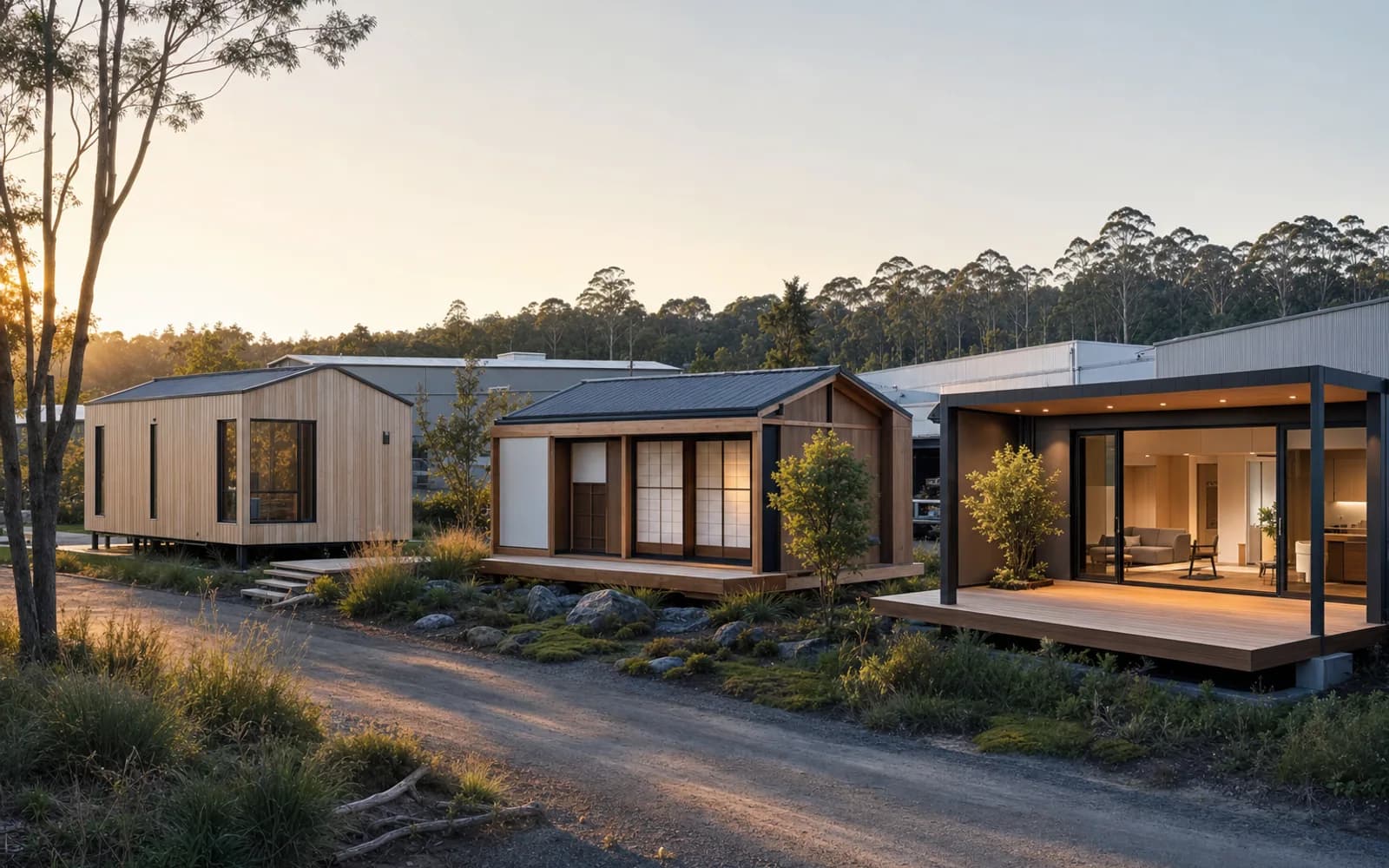
If modular and prefabricated construction is faster, more cost-predictable and built to the same standards as conventional building, a natural question follows: why isn't everyone doing it? Some countries essentially already are. Sweden and its Nordic neighbours build a substantial share of new housing off-site. Japan isn't far behind. Australia, by comparison, remains at a fraction of that level — despite facing many of the same pressures (labour shortages, housing supply targets, rising costs) that have pushed other countries toward factory-built housing. This article looks at the actual data behind these numbers, where they come from, and why the gap exists.
The numbers, and where they come from
It's worth being precise here, because a widely circulated figure for Sweden — often quoted as 84% — doesn't hold up well under scrutiny. That number appears across many market research summaries without a clear original source, and it likely reflects a broader definition (any detached home containing some prefabricated components, such as factory-made wall panels) rather than genuinely modular, factory-built construction.
The more carefully sourced figure comes directly from McKinsey & Company, the international consultancy whose 2019 and 2023 research on modular construction is the most frequently cited industry analysis in this space. McKinsey's own published data puts the offsite share of housing construction at:
- 01Finland, Norway and Sweden (combined): approximately 45%
- 02Japan: approximately 15%
- 03Germany: approximately 10%
- 04China: approximately 6%
- 05Australia and the United Kingdom: approximately 5% each
- 06United States: approximately 3–4%
Separately, Savills Research (2020) put Sweden's offsite construction share at around 45% on its own, and Japan's Modern Methods of Construction (MMC) share at 15–20% of new homes — broadly consistent with McKinsey's figures, and equating to roughly 150,000–180,000 homes built this way annually in Japan alone, a genuinely large industrial sector rather than a niche.
For Australia specifically, a 2026 peer-reviewed study on the economic challenges facing prefabricated construction in Australia confirms the local industry's market share remains limited at roughly 5% of construction activity — consistent with the international comparison above, and from a source with more rigour than a market-research summary.
The takeaway: the widely repeated "Sweden 84%" figure overstates the case. The real, better-sourced comparison is still striking — a roughly ninefold difference between the Nordic countries and Australia — without needing to inflate it.
Why Sweden and the Nordic countries lead
A few factors show up consistently in the research on why offsite construction became mainstream in Sweden specifically, rather than staying a niche method:
- 01Climate. Long, harsh winters with limited daylight make outdoor, weather-exposed construction genuinely difficult for large parts of the year. Building indoors, in a factory, sidesteps this entirely — it's less a lifestyle preference than a practical response to the conditions.
- 02Timber industry integration. Sweden's large domestic timber and sawmill industry feeds directly into offsite construction, keeping input costs predictable and giving local manufacturers a structural cost advantage that's harder to replicate in countries reliant on imported materials.
- 03Decades of industry maturity. Sweden's offsite sector has had a long runway to refine manufacturing processes, build institutional trust, and develop major players — companies like BoKlok (a joint venture between Skanska and IKEA) have been operating since the mid-1990s, giving the market decades to normalise factory-built housing as a mainstream choice rather than an alternative one.
- 04Municipal procurement shifting toward life-cycle cost. Local governments increasingly assess bids on total cost of ownership rather than headline construction price, which tends to favour manufacturers who can demonstrate cost certainty through factory-based production.
Why Japan sits in the middle
Japan's roughly 15% share reflects a different but related set of drivers: a mature manufacturing culture generally, a track record of prefabricated homes reselling at a premium over site-built equivalents (unusual internationally, where prefab has often faced a resale stigma), and decades of building code development specifically supporting industrialised, quality-controlled housing production. Major manufacturers like Sekisui House have built long-term brand trust around durability and standardisation — arguably the opposite of the "cheap and generic" perception that still lingers in some other markets.
Why Australia has lagged
The research points to a combination of structural and cultural factors, not a single cause:
- 01A fragmented, project-based construction culture. Much of Australian home building runs through a large number of small and mid-sized builders working on individual, one-off projects — a structure that doesn't naturally scale toward the kind of repeated, standardised production that makes offsite manufacturing cost-effective.
- 02Persistent perception issues. Modular and prefab construction has historically carried associations with temporary, low-quality, or institutional buildings (classrooms, site sheds) in Australia, an image the industry is still working to shift — even though, as covered in our structural standards guide, a permanent Class 1a modular home is built to identical Australian Standards as any house.
- 03Regulatory and certification friction. Fragmented approval pathways across states and councils, discussed throughout our council approval guides, have historically made it harder for manufacturers to scale a single certified product nationally, unlike countries with more centralised building approval systems.
- 04A construction industry not yet organised around volume manufacturing. Unlike Sweden's timber-industry integration, Australia's construction supply chain has developed around on-site trades and project delivery rather than factory production — the industry structure itself, not just demand, has been a constraint.
What's changing
This is genuinely a shifting picture, not a static one. Several developments now point toward Australia's share growing:
- 01The Australian National Housing Accord target of 1.2 million new homes has intensified government interest in construction methods that can scale faster than traditional building, given persistent trade labour shortages — the Housing Industry Association has estimated a shortfall of over 80,000 tradespeople nationally.
- 02prefabAUS, the national industry body, has projected prefabrication could reach approximately 10% of Australian homes by 2030 — roughly double the current share, though still well short of the Nordic countries.
- 03State government programs in NSW, Victoria and Western Australia are actively backing modular housing for social and affordable housing delivery, including the NSW Modern Methods of Construction Industry Expansion Program (MMCIEP), which is specifically inviting prefab and modular businesses to help scale local manufacturing capacity.
- 04NCC 2022's energy efficiency requirements (the 7-star NatHERS standard) are, if anything, easier to hit consistently in a factory-controlled environment than on a variable building site — a genuine point in modular's favour as compliance requirements tighten nationally.
What this means for the housing conversation
The comparison isn't really "Australia is behind" in a simple sense — it's that Australia's construction industry developed along a different structural path, and is now facing the same pressures (labour shortages, housing supply targets, cost predictability demands) that pushed Sweden and Japan toward offsite manufacturing decades ago. The Nordic and Japanese examples suggest this kind of shift, once it takes hold, tends to be durable rather than a passing trend — Sweden's offsite share has been high for decades, not a recent spike.
For regional Australian builders specifically, this gap represents genuine opportunity rather than just a statistic: the countries furthest ahead got there through manufacturers and builders working together at scale, not through any single company solving it alone.
Frequently asked questions
What percentage of homes in Sweden are modular or prefabricated?
The most reliable figure, from McKinsey & Company's research, puts offsite construction at approximately 45% across Finland, Norway and Sweden combined — Savills Research independently estimates Sweden alone at a similar level. A commonly cited "84%" figure lacks a clear original source and likely reflects a broader definition of "contains some prefabricated components" rather than genuinely modular construction.
What percentage of homes in Japan are prefabricated?
Approximately 15% of new homes in Japan use offsite or modular construction methods, according to McKinsey & Company and Savills Research, equating to roughly 150,000–180,000 homes annually — a substantial, mature industrial sector rather than a niche method.
What percentage of Australian construction is modular or prefabricated?
Approximately 5%, according to McKinsey & Company's international comparison and confirmed by a 2026 peer-reviewed academic study on Australia's prefabricated construction industry. prefabAUS, the national industry body, has projected this could grow to around 10% by 2030.
Why is modular construction more common in Sweden and Japan than Australia?
Several factors contribute: Sweden's harsh climate makes indoor factory construction practical, its timber industry is closely integrated with offsite manufacturing, and the sector has had decades to mature. Japan has a strong manufacturing culture and prefabricated homes that resell at a premium. Australia's construction industry developed around fragmented, project-based building rather than volume manufacturing, alongside historical perception issues and fragmented state-based approval pathways.
Is Australia's modular construction market growing?
Yes. prefabAUS projects prefabrication could reach approximately 10% of Australian homes by 2030. Government programs including the NSW Modern Methods of Construction Industry Expansion Program, alongside persistent construction labour shortages and NCC 2022's tightening energy efficiency requirements, are all pushing toward greater adoption.
The bottom line
The real, carefully sourced numbers are striking enough without exaggeration: Nordic countries build roughly 45% of housing offsite, Japan around 15%, and Australia around 5% — a genuine, multi-decade gap rather than a marginal difference. It reflects industry structure and history as much as anything about the method itself, since a permanent modular home built in Australia meets identical structural and energy standards to a site-built one. What's changing is the pressure: labour shortages, housing targets and tightening energy standards are pushing Australia toward the same conditions that made offsite construction mainstream in Sweden and Japan decades ago.
ModuHaus is built around exactly this shift — bringing standardised, Class 1a certified modular product to Australian builders and developers who want to build toward where the industry is heading, not just where it's been.
**Start your Planning Assessment →**
This article is general information only. Market share figures vary by source, methodology and year, and are approximate. Figures are drawn from McKinsey & Company, Savills Research and peer-reviewed academic literature as cited; always confirm current statistics against primary sources for critical decisions.
Last updated: 23/07/2026. Verified against McKinsey & Company, Savills Research and academic sources on 23/07/2026.
Sources and further reading
Requirements change and can be applied differently by site and local authority. Check the current official sources and confirm your project with the relevant council, certifier or qualified professional.