
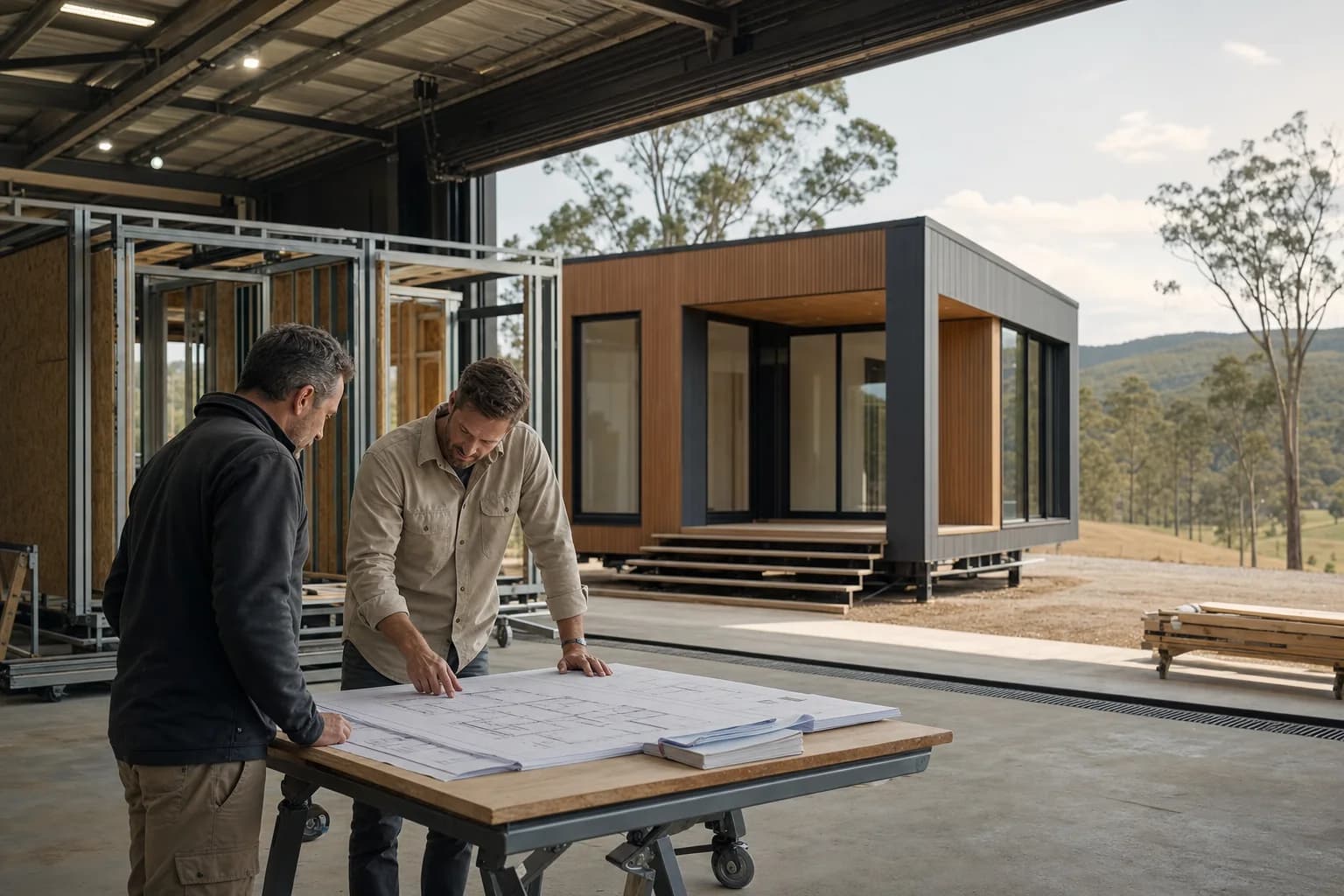
Most regional builders who look seriously at modular construction stop at the same wall: building a genuine modular capability — factory production, structural engineering, NCC compliance, a certified product range — is a multi-year, multi-million-dollar undertaking. For a business doing 30 to 200 homes a year, that math rarely works. But there's a second path that doesn't require any of it: partnering with an established modular supplier and adding their certified product to your existing House & Land offering, under your own sales process and, where it makes sense, your own brand. This is what that actually looks like in practice.
The problem this solves
Regional building businesses are being squeezed from a specific direction right now: labour, not demand. Trade shortages in carpentry, bricklaying, roof plumbing and electrical mean the bottleneck in most regional markets isn't finding buyers — it's finding the crews to build for them fast enough. A traditional site build ties up land, finance and a construction team for months longer than it needs to, in a market where every month of delay is a real cost.
Modular doesn't remove your need for site labour entirely — foundations, connections and finishing still happen locally. But it moves the majority of construction hours into a factory, running in parallel with your site works rather than after them. For a business trying to grow volume without growing headcount at the same rate, that's the actual lever.
Two ways to add modular — and why "buy the product" beats "build the capability"
Option A: Build your own modular capability. Factory, engineering team, NCC compliance and certification pathway, a proven product range. This is the path the largest national builders can justify. For a regional business, it means years of capital investment before the first home ships, with no guarantee the product range lands with your local market.
Option B: Partner with an established supplier. You add a certified Class 1A product to your existing sales and land pipeline. The factory, engineering and compliance already exist. Your investment is in integrating the product into your process, not building the underlying capability from scratch.
For a business at the 30–200 home/year scale, Option B is almost always the more sensible entry point — it lets you test modular demand in your market with real product, real margin data and real customer response, before deciding whether deeper investment makes sense.
What this actually adds to your business
Speed, without losing site control. Factory production runs while your site team handles foundations and civil works — the two timelines run in parallel rather than in sequence. You're not handing off the project; you're removing the part of the build that was costing you the most calendar time.
Cost predictability. A pre-engineered, certified product range means fewer surprises in the build cost — useful both for your own margin planning and for offering buyers a firmer number earlier in the sales process.
A lighter-asset way to add capacity. You can take on more projects without proportionally growing your on-site crew, because a smaller share of total labour hours happens on your site.
A product that fits inside what you already sell. This isn't a separate product category competing with your core offering — it's a build method for the same House & Land Package you already sell, integrated into your existing land, sales and finance process.
How the partnership actually splits
This is the part builders usually want mapped out clearly before going further:
| ModuHaus provides | You provide | |
|---|---|---|
| Product | Class 1A standardised product range, factory production | Land, and the House & Land Package it's sold within |
| Engineering & compliance | Structural engineering, NCC/BASIX and energy compliance documentation | — |
| Sales | — | Customer relationships, sales process, pricing to your market |
| Approvals | Manufacturer certification and drawings | DA/CDC lodgement and local council management |
| Site | Delivery, installation, installation manual, ITP | Foundations, site connections, finishing coordination |
| After delivery | Manufacturer warranty support, quality assurance | Site-related defects, customer relationship, warranty coordination |
| Branding | Product and compliance documentation | Can be sold under your own brand (white-label/OEM arrangement) |
The full detail of how this splits — including where responsibility for design changes, defects and warranty claims sits — is covered in our companion piece, Modular Partnerships: Where Does Responsibility Actually Sit?
What the product range looks like
A standardised range built around the sizes regional buyers actually ask for, using language your sales team and customers already understand:
| Range | Size | Bedrooms |
|---|---|---|
| Entry | ~60m² | 2 |
| Starter | ~80m² | 3 |
| Family | ~100m² | 3 |
| Premium | ~120m² | 4 |
This range is a starting framework, refined against transport constraints, factory capability and what specific regional markets are asking for — not a fixed catalogue with no room to adjust.
The context this sits in
NSW is actively backing this shift. The state's Modern Methods of Construction program — including the Modern Methods of Construction Industry Expansion Program, which sought expressions of interest from prefab and modular businesses through to early August 2026 — reflects a broader government push to scale modular capacity across the state, alongside record public investment in modular social housing delivery. For regional builders, the direction of travel is clear even independent of any single program: state and industry momentum is moving toward modular becoming a mainstream, not niche, construction method — while Australia's overall prefabrication share remains around 5% of construction activity, well behind Japan (~15%) and the Nordic countries (~45%). That gap is the opportunity: builders who move early build the relationships, process and local trust while the category is still forming, not after it's crowded.
Where regional transport actually works in your favour
One thing worth correcting directly: regional NSW is often better suited to modular delivery than metro Sydney, not worse. Towns connected by highway — Orange, Dubbo, Bathurst, Tamworth, Wagga Wagga, Albury among them — frequently offer more practical large-module transport routes than dense inner-city streets. Site-specific factors (module dimensions, permits, escort requirements, final-kilometre access) still need assessing project by project, but distance from a capital city is not, on its own, the obstacle it's often assumed to be.
What a genuine partnership conversation covers
Before any commercial commitment, a real evaluation should cover:
- Step 01Your target buyer and price point — does the product range fit what you're actually selling in your market?
- Step 02Your land pipeline — how many sites, over what timeframe, could realistically use this product?
- Step 03Your current approval and delivery capacity — what would change in your DA process, your site scheduling, your finance conversations?
- Step 04A pilot, not a rollout — one to three projects to test the model, generate real cost and timeline data, and confirm fit before scaling.
- Step 05Branding preference — sold under your name, under ModuHaus, or co-branded — this is a genuine choice, not a fixed requirement.
Frequently asked questions
Can a regional builder offer modular homes without building a factory?
Yes. Partnering with an established modular manufacturer means you add a certified, pre-engineered product to your existing House & Land offering without the capital or time required to build factory, engineering and compliance capability yourself. You continue to manage land, sales and DA/CDC approval; the manufacturer handles product, engineering compliance and factory production.
Can I sell modular homes under my own brand?
Often yes, through a white-label or OEM-style arrangement — the product and compliance documentation come from the manufacturer, but the customer-facing sale can run under your existing brand and sales process. Confirm branding terms directly as part of any partnership agreement.
How does modular help with regional labour shortages?
By moving a substantial share of construction hours into factory production, which runs in parallel with your site works rather than requiring your own crew to complete the full build sequence on-site. Foundations, connections and finishing still need local labour, but the overall on-site labour requirement per project is reduced.
Is regional NSW well suited to modular home delivery?
Often more so than metro areas. Many regional NSW towns are connected by highway routes that can be more practical for large-module transport than dense inner-city streets. Site-specific factors like access, permits and escort requirements still need project-by-project assessment, but distance from a capital city isn't inherently a barrier.
What's the first step to evaluate a modular partnership?
Start with your target buyer profile, price point and land pipeline to assess genuine fit, then evaluate with a small pilot — one to three projects — rather than a full rollout. This generates real cost, timeline and customer response data before any larger commitment.
The bottom line
For a regional builder or House & Land developer, the choice isn't "modular or not" — it's "build the capability yourself, or add an existing certified product to what you already sell." The second path is faster, requires far less capital, and lets you test real market response before committing further. With state government momentum building behind modern construction methods and regional NSW's transport advantages working in your favour, the businesses that evaluate this now are positioned ahead of a category that's still forming — not competing in one that's already crowded.
ModuHaus works with regional NSW builders and developers to integrate Class 1A modular product into an existing House & Land business — product, engineering and compliance from us; land, sales and delivery from you.
**Discuss a Builder Partnership →**
This article is general business information, not financial, legal or investment advice. Partnership terms, product availability and program details referenced (including government initiatives) should be confirmed directly and independently before making commercial decisions.
Last updated: 23/07/2026.
Sources and further reading
Requirements change and can be applied differently by site and local authority. Check the current official sources and confirm your project with the relevant council, certifier or qualified professional.