
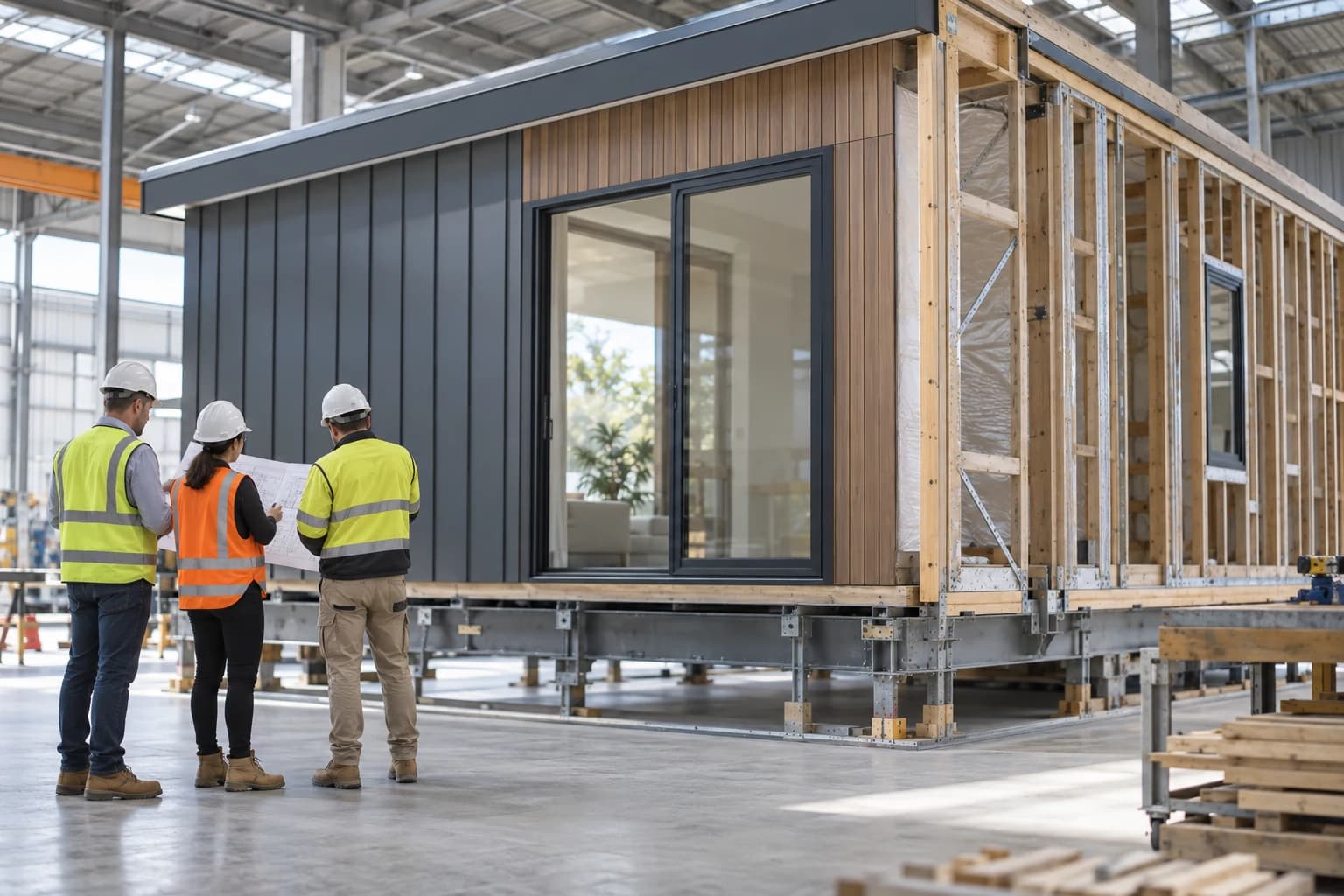
For years, a modular home in New South Wales occupied a strange legal position. The physical build could be identical to a conventional house in every respect — same materials, same engineering, same finished result — yet the term "manufactured home" carried a specific exemption in state planning law that meant modular and prefabricated buildings weren't automatically treated the same way as a house built on-site. That changed in 2026. NSW has passed legislation that, for the first time in Australia, formally recognises modern methods of construction (MMC) in law. This article explains what actually changed, why it matters, and what's still to be worked out.
The short answer
The Building (Approvals and Practitioners) Bill 2026 passed the NSW Legislative Assembly on 28 May 2026 and began taking effect from August 2026, with modular-specific provisions commencing first, on the date of assent, ahead of the rest of the Bill. It makes NSW the first Australian jurisdiction to formally define "prefabricated buildings" in legislation and bring modern methods of construction into the mainstream approvals system — with the explicit goal of removing regulatory barriers that had held modular and prefabricated housing back, without lowering building quality requirements.
This is a genuinely significant reform, not a minor administrative tweak. It touches three things that matter directly to anyone considering a modular home: what a modular home is legally classified as, what approval documents you'll receive, and what consumer protections apply.
What actually changes: three concrete shifts
1. Modular homes lose their old planning exemption — and gain equal treatment
Previously, the Environmental Planning and Assessment Act 1979 (NSW) contained a "manufactured home" exemption from the general definition of "building." In practice, this meant modular and prefabricated homes sat in a kind of regulatory grey area, sometimes assessed alongside caravans and relocatable homes rather than as conventional buildings.
The new Bill removes this exemption entirely. A prefabricated dwelling now receives the same regulatory treatment as any other dwelling under NSW planning law. This has two practical effects: it simplifies where prefabricated buildings are permitted under land use zoning (removing some previously inconsistent outcomes), and it means the consumer protections already available under the Home Building Act 1989 (NSW) — protections conventional home buyers have long had — now extend to prefabricated buildings captured as residential building work under that Act.
For a genuine, permanent Class 1a modular home, this is largely a formalisation of what was already true in practice — but it closes a gap that previously created inconsistency and uncertainty, particularly for lenders, insurers and buyers comparing modular against conventional builds.
2. Construction Certificates and Occupation Certificates are being replaced
This is the change most likely to affect anyone with a project already in progress or about to start. Under the previous system (Part 6 of the EP&A Act), a build required a Construction Certificate before work began and an Occupation Certificate before it could be lawfully occupied.
The new Bill removes these certificate types from Part 6 of the EP&A Act and replaces them with a new, standalone regime:
- 01Construction Certificate → Building Approval
- 02Occupation Certificate → Completion Approval
The new terminology reflects a broader restructure: building-related approvals are being consolidated into their own dedicated legislation, separate from (but sitting alongside) the planning consent framework in the EP&A Act. Development consent alone will not authorise building work — a building approval is required unless the work qualifies as complying development.
What this means practically: if your project documentation still refers to a Construction Certificate or Occupation Certificate, that terminology is being phased out. It's not yet clear exactly how the transition will be staged for projects already underway — this is one of several implementation details still to be finalised (see below).
3. New obligations for prefabricated building manufacturers and suppliers
The Bill doesn't just relax rules — it also tightens accountability in specific ways for the modular industry itself. Manufacturers and suppliers of prefabricated and modular buildings should expect closer scrutiny of Building Code of Australia (BCA) compliance, along with new requirements to provide formal declarations of compliance and installation instructions accompanying delivered modules. The intent, according to the NSW Government, is to guarantee consumer protections while removing the barriers that had held MMC back — not to trade quality for speed.
For genuine Class 1a suppliers already operating to a real certification chain, this formalises documentation that a properly run operation should already be producing. For buyers, it's a positive: it makes "show me the compliance declaration" a legal expectation, not just good practice.
Why the government made this change
The reform sits inside a broader housing supply push. According to the NSW Government's own release, the Commonwealth Productivity Commission has estimated that MMC — including modular and prefabricated construction — can reduce overall building costs by up to 20% and be up to 50% faster to build than conventional construction. With NSW facing a well-documented housing supply and construction labour shortage, formally recognising and streamlining MMC is positioned as a direct lever on both cost and delivery speed.
The government has backed this with real budget commitment: $32.3 million in the 2026/27 NSW Budget is allocated to implementing the new laws, including modernising the building approvals system, integrating it into the NSW Planning Portal, and piloting AI tools to speed up licence application processing.
Industry response has been positive. The Urban Development Institute of Australia (UDIA) publicly welcomed the passage of the Bill, specifically noting that it "removes the duplicate regulations that have been holding back manufactured homes in land lease communities across NSW."
What this means for the "product catalogue" model
One detail worth understanding if you're comparing modular suppliers: the reform is expected to reduce duplicated design and compliance costs specifically because modular construction can reuse a certified design across multiple projects, rather than requiring fresh drawings and compliance work for every build — sometimes referred to as a "product catalogue" approach, transferable from project to project. This is a structural reason modular costs can come down further as the regulatory framework matures, on top of the factory-efficiency reasons already well understood.
What's still unresolved
It's important to be direct about the limits of what's confirmed so far. Several practical details remain to be worked out, primarily through regulations still to be released rather than the Bill's text itself:
- 01Exact commencement timing for the balance of the Bill. The modular-specific provisions took effect first, on assent, but most of the Bill's other provisions commence only once the government proclaims the supporting EP&A Act and Regulation changes. Independent legal commentary has indicated full commencement of the Act is expected around 2027, with regulations to be drafted progressively through 2026-2027 — but this should be treated as an estimate, not a confirmed date, until the government proclaims it directly.
- 02What counts as a "prefabricated building." The Bill defines a prefabricated building as one manufactured away from the site, including a modular building component that becomes a building element once installed and cannot be inspected without destructive testing or opening. Importantly, "moveable dwellings" — tents, caravans and other portable devices used for human habitation, whether on wheels or not — are explicitly excluded from this definition. A permanent, fixed Class 1a modular home falls within the new prefabricated building framework; a caravan-style or wheeled tiny home does not.
- 03Verification detail for overseas-manufactured modules. How compliance will be checked for modules manufactured outside Australia, and at what stage of the supply chain, is not yet finalised.
- 04Transition arrangements for projects already underway. How current Construction Certificate/Occupation Certificate processes convert to the new Building Approval/Completion Approval regime for in-progress projects has not been fully detailed publicly at this stage.
Treat any specific claim about "what you need right now" with appropriate caution until the supporting regulations are published — and confirm current requirements directly with your certifier or the NSW Planning Portal before relying on any single source, including this one.
What this means if you're considering a modular home in NSW right now
- Step 01The direction of travel is unambiguous and favourable. NSW has committed, in law and in budget, to treating genuine modular and prefabricated homes as equivalent to conventional builds — not a lesser or exempt category.
- Step 02Terminology in contracts and documentation is changing. Don't be alarmed if you see both old (Construction/Occupation Certificate) and new (Building/Completion Approval) terms in circulation over the transition period — confirm with your certifier which regime applies to your specific project timeline.
- Step 03Ask suppliers about BCA compliance documentation now, not later. The Bill signals that formal compliance declarations and installation documentation will be a legislated expectation, not just best practice — a supplier who already provides this is ahead of where the law is heading, not just meeting a future requirement.
- Step 04This does not change Class 1a fundamentals. The structural, energy efficiency and certification standards a genuine Class 1a home must meet haven't changed — see our guide on Class 1a certification. What's changed is the clarity and consistency of the legal and administrative framework around those standards.
Frequently asked questions
What is the Building (Approvals and Practitioners) Bill 2026?
It's NSW legislation, passed in 2026, that consolidates building approvals, certification and practitioner obligations into one regime. It makes NSW the first Australian jurisdiction to formally recognise modern methods of construction (MMC), including modular and prefabricated buildings, in law — removing a previous planning exemption that had treated manufactured homes inconsistently with conventional buildings.
Are Construction Certificates and Occupation Certificates being removed in NSW?
Yes. Under the new Bill, Construction Certificates and Occupation Certificates are being removed from Part 6 of the Environmental Planning and Assessment Act 1979 and replaced with a new Building Approval and Completion Approval regime. The exact transition timing for projects already underway had not been fully detailed publicly as of this article.
Does this mean modular homes are treated the same as regular houses in NSW now?
Largely yes, for planning purposes. The Bill removes the "manufactured home" exemption from the definition of "building" under NSW planning law, meaning a prefabricated dwelling now receives the same regulatory treatment as any other dwelling, and consumer protections under the Home Building Act 1989 extend to prefabricated buildings captured as residential building work.
When does the new law take effect?
Modular-specific provisions took effect first, from the date of assent. Most of the Bill's remaining provisions commence once the NSW Government proclaims supporting changes to the Environmental Planning and Assessment Act and Regulation — no fixed date for full commencement was confirmed as of this article's publication.
Why did NSW introduce this reform?
To address housing supply and affordability pressure. The Commonwealth Productivity Commission estimates MMC can reduce building costs by up to 20% and cut build times by up to 50% compared to conventional construction. The reform aims to remove regulatory barriers that had historically slowed MMC adoption, backed by $32.3 million in the 2026/27 NSW Budget for implementation.
The bottom line
This is the most significant piece of modular-specific legislation NSW — or any Australian state — has passed. It formally ends the legal ambiguity that previously separated "manufactured homes" from conventional buildings, replaces familiar certificate terminology with a new approvals regime, and backs the shift with real budget and industry support. Some implementation detail is still to come, and it's worth confirming current requirements directly with your certifier during the transition period. But the direction is unambiguous: NSW has decided that a genuine modular home should be regulated — and trusted — the same way as any other home.
ModuHaus builds permanent, Class 1a modular homes engineered and certified to full NCC standards — the same standards this reform is designed to bring into clearer, more consistent regulatory focus. A Planning Assessment is the place to understand how these changes apply to your specific project.
**Start your Planning Assessment →**
This article is general information only and not legal or planning advice. Legislative reforms are subject to ongoing regulation-making and transitional arrangements. Always confirm current requirements with your certifier, the NSW Planning Portal, or a qualified legal professional before making project decisions.
Last updated: 06/08/2026. Verified against NSW Government official statements and independent legal analysis (Clayton Utz, Gadens, Holding Redlich, Lockton) on 06/08/2026.
Sources and further reading
Requirements change and can be applied differently by site and local authority. Check the current official sources and confirm your project with the relevant council, certifier or qualified professional.