
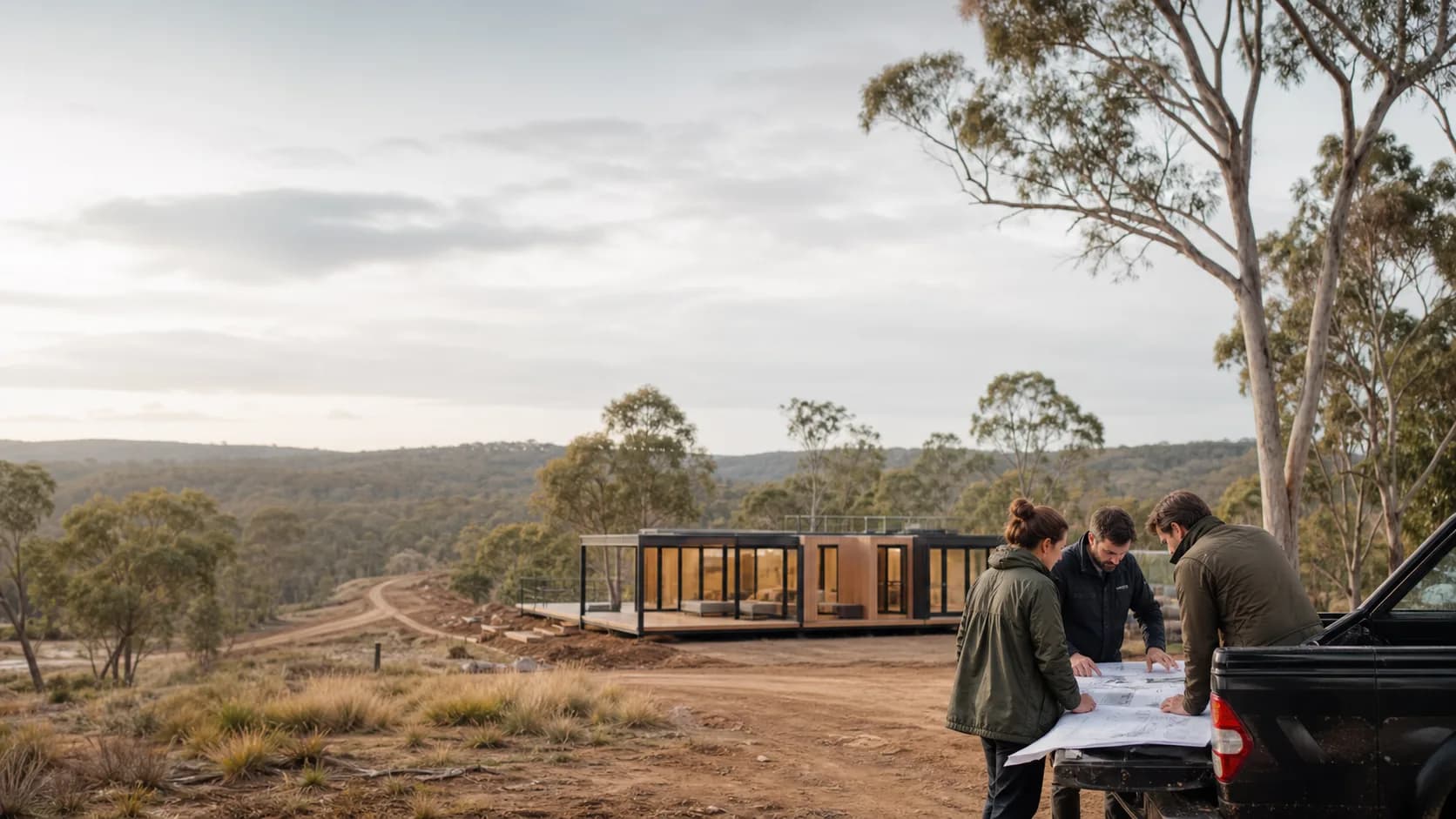
A modular home is not an investment outcome by itself. Feasibility depends on the lawful use, complete project cost, finance, local demand and the operating assumptions that remain after the home is delivered.
Use this checklist to organise evidence before comparing a rental yield or committing to a product. It is general project-planning information, not financial, tax, legal, property or rental advice.
Define the proposed use before the return
The same building can lead to different project questions depending on how it will be used. Do not use granny flat, short stay, rental and permanent home as interchangeable labels.
| Proposed use | First questions to resolve | Evidence to gather |
|---|---|---|
| Family or granny-flat use | Is a lawful secondary-dwelling pathway available? | Property controls, occupant needs, access, privacy and services |
| Long-term rental | Can it be lawfully occupied and rented as proposed? | Local rental appraisal, vacancy evidence, management and operating costs |
| Short-stay accommodation | Is the use permitted and operationally workable? | Planning advice, registration or management requirements, cleaning and booking costs |
| Permanent residence | Does the home, site and approval pathway support residential occupation? | Classification, approvals, finance, services and completion evidence |
NSW describes a secondary dwelling as a self-contained dwelling on the same site as another dwelling. Its approval route depends on the land and proposal. Start with the NSW secondary-dwelling guidance and the NSW ModuHaus approval guide.
Victoria states that a qualifying small second home is 60 square metres or less on the same lot as an existing home. It may avoid a planning permit in many cases, but a building permit is still required. Check the current Victorian small-second-home guidance and the Victoria approval guide.
Prepare the minimum feasibility dataset
- 01Property address, ownership or site-control position and intended use
- 02Survey, title, easements, zoning, overlays and known site constraints
- 03Concept position, access route, services, wastewater and site-work assumptions
- 04Current product drawings, inclusion schedule and written quotation scope
- 05Complete development budget, finance assumptions and contingency
- 06Independent rent or occupancy evidence for the proposed use and location
- 07Vacancy, management, insurance, maintenance, utilities and compliance costs
- 08Delivery, handover and operating responsibilities with a named owner for each item
Record the source and date beside every figure. Mark an input as unconfirmed when it comes from a marketing estimate, an old quotation or a different property.
Separate the product price from the cost base
Use the complete cost of reaching a lawful, usable and lettable outcome. Add any excluded design, approvals, engineering, foundations, transport, lifting, installation, connections, external work, professional fees, finance costs and contingency to the product quote.
The NSW and Victoria modular-home budget guide provides a scope worksheet. The complete modular-home cost guide explains why two advertised prices may not describe the same project boundary.
Test income, vacancy and operating costs together
ASIC Moneysmart notes that rental income may not cover mortgage payments and other expenses, and that vacancy can leave the owner carrying the costs. Review its current property investment guidance.
Build at least a base case and a downside case. Change rent, occupied weeks, operating expenses, interest or debt service, delivery timing and contingency. A result that only works at full occupancy with no maintenance allowance is not a resilient feasibility case.
Use the rental cash-flow worked example to distinguish scheduled rent, collected rent, operating surplus and cash flow after debt service.
Assign every confirmation to the right party
| Question | Typical confirmation source |
|---|---|
| Lawful use and approval pathway | Council, planner, certifier or building surveyor |
| Current design and product inclusions | Selected supplier in current written documents |
| Foundations, services and site work | Appointed engineer, builder and relevant trades |
| Rent, vacancy and management costs | Appropriately licensed local property provider |
| Lending, valuation and payment structure | Lender, broker and valuer |
| Tax, ownership and legal structure | Qualified tax and legal advisers |
ModuHaus can help organise the product, site, supplier and delivery questions through the Investment Feasibility pathway. It does not confirm an approval, rent, occupancy, valuation, loan or return.
Use a decision gate before proceeding
Proceed to a more detailed proposal only when the intended use has a credible pathway, the cost boundary is understood, the downside case is affordable and the unresolved items have owners and due dates.
Compare Permanent Homes after that first project boundary is clear. Request current drawings, inclusions, certification evidence, transport requirements, warranty terms and site-specific pricing from the relevant supplier before purchase.
Sources and further reading
Requirements change and can be applied differently by site and local authority. Check the current official sources and confirm your project with the relevant council, certifier or qualified professional.