
Off-grid & rural

Off-Grid Modular Homes in Australia: Solar, Water & Waste

Off-grid modular projects bring power, water and wastewater into one site-specific design. Size each system for the land, climate and actual household use, and begin wastewater approval early.

Reading time
8 min read
Author
Author: ModuHaus Editorial Team
Last updated
Last updated: 16 July 2026
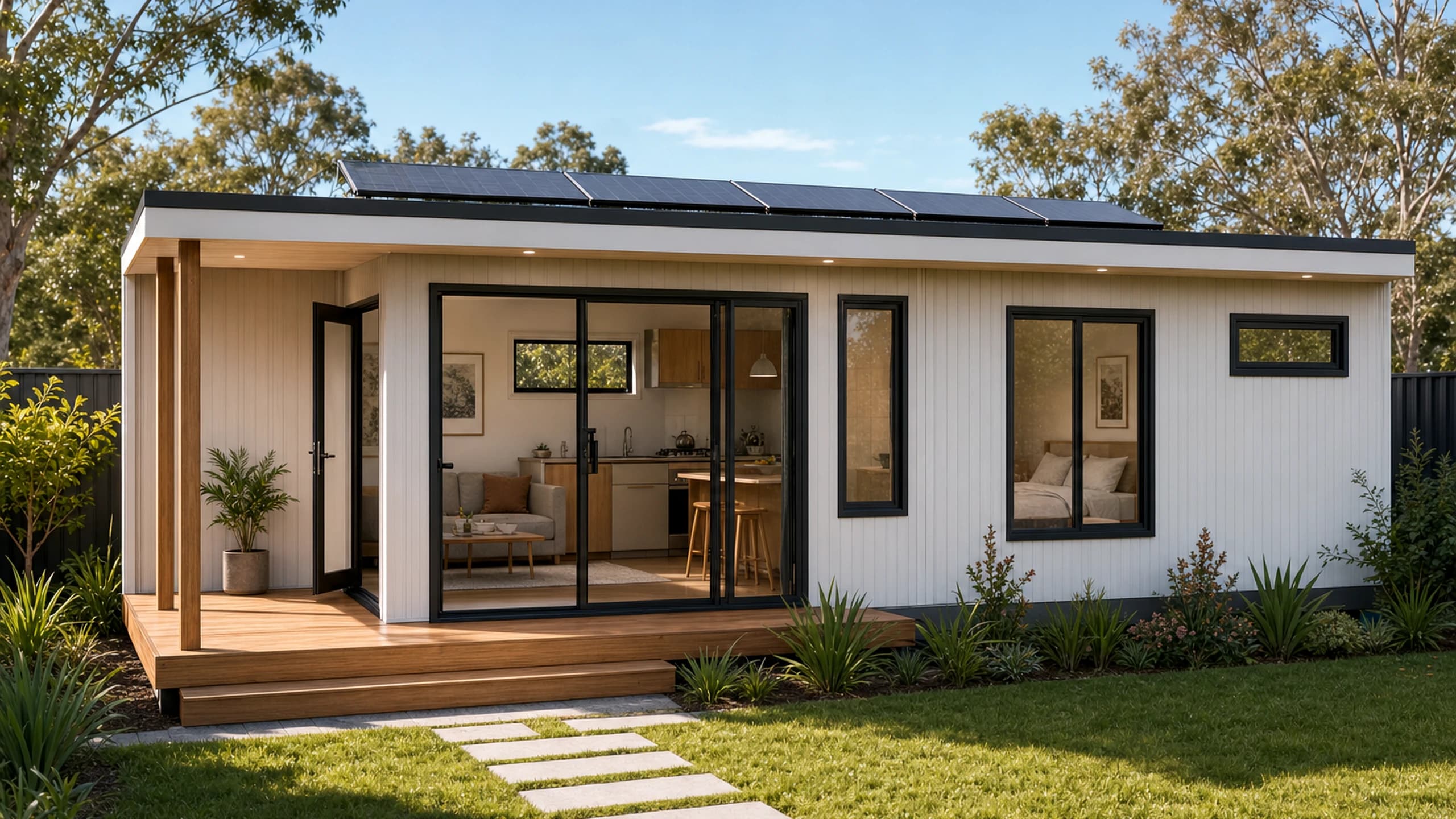
Permanent modular home with rooftop solar panels on an Australian bushland site

Off-grid living in Australia isn't the fringe choice it once was. On plenty of rural blocks, going off-grid isn't ideological — it's simply cheaper than paying to run a power line, and more reliable than waiting for one. Modular homes suit this well, because the services can be designed and engineered before the home ever reaches the site. This guide covers the three systems that make an off-grid home work — power, water and wastewater — plus the approvals they need and what to think about before committing.

Why modular suits off-grid

An off-grid home lives or dies on its systems. Getting them right requires planning them together — power sizing informed by the home's loads, water storage matched to the roof area and rainfall, wastewater suited to the soil.

A modular home makes this easier because the home is a known quantity before it arrives. Its roof area, orientation, appliance loads and layout are all fixed at design stage, so the solar array, tank sizing and wastewater system can be engineered around a real specification — not worked out piecemeal as an on-site build evolves.

The practical result: off-grid systems designed alongside the home, rather than retrofitted around it.

Power: solar and battery

For most Australian off-grid homes, solar with battery storage is the backbone.

Typical residential off-grid setup:

  • Solar array: commonly 6–15kW, sized to the home's loads and your location's solar resource
  • Battery storage: commonly 10–20kWh, enough for roughly 2–4 days without meaningful sun
  • Backup generator: diesel or LPG, for extended cloudy periods or unusual loads

What drives the sizing:

  • Your daily energy use — a two-person home is a very different system from a family with a workshop
  • Location — solar yield varies significantly between, say, far north Queensland and southern Victoria
  • Seasonal variation — winter output in southern Australia is the constraint that usually sets array size
  • Whether you have a generator — a backup allows a slightly smaller battery bank

A note for Victoria: since 2024, new dwellings in Victoria (including second dwellings) cannot connect to reticulated natural gas — they must be all-electric. This makes solar and battery a natural fit rather than an alternative, since the home is electric regardless.

Water: rainwater, bore and treatment

Rainwater harvesting is the most common off-grid supply. Sizing depends on roof area, local rainfall and how many people the home supports — 20,000 to 45,000 litres of storage is a common range for year-round supply in much of Australia, but this varies significantly by region. Dry-region blocks need considerably more storage; high-rainfall areas need less.

Bore water is an option where groundwater is accessible and licensed. Quality varies — bore water often needs treatment for potable use, and drilling has its own cost and approval requirements.

Treatment for potable supply typically includes filtration and UV sterilisation, with a pressure pump to deliver mains-like pressure through the home.

The practical planning question is simple: how many days of storage do you have in your driest realistic season? That, more than any rule of thumb, sets your tank size.

Wastewater: the approval that matters most

This is the system most likely to shape your timeline, because it needs its own approval.

The common options:

  • Septic tank — the traditional system, suitable where soil and site conditions allow effluent disposal
  • Aerobic Treatment Unit (ATU) — treats wastewater to a higher standard, often required on sensitive land, smaller lots, or where soil absorption is poor. Treated water can typically be used for irrigation
  • Composting toilet — uses no water for the toilet, which reduces both water demand and wastewater volume. Often the simplest system in remote locations, though greywater still needs managing
  • Greywater treatment and irrigation — handling shower, laundry and kitchen water separately for garden reuse

The approval point: an on-site wastewater management system requires its own approval, separate from your building approval — a Section 68 approval in NSW, and equivalents in other states. Councils assess the proposed system against soil conditions, site slope, distance to waterways and lot size.

Some councils in sensitive catchments restrict greywater irrigation or require higher-treatment systems. Because this approval is assessed on your specific soil and site, it's often the longest-lead item in an off-grid project — and the one worth starting first.

Who off-grid modular homes suit

  • Rural and agricultural land not connected to services, where grid connection is expensive or unavailable
  • Remote and regional buyers in QLD, WA and NT where distances make connection costs prohibitive
  • Lifestyle and self-sufficiency blocks where independence is the goal, not just the outcome
  • Buyers wanting energy independence regardless of whether the grid is available

For many, the deciding factor is simply arithmetic: if a grid connection quote is $40,000 and a solar-battery system is $30,000, off-grid is the cheaper and more independent choice.

What to plan for

  1. 1. Get a grid connection quote — you can't know if off-grid is cheaper without it.
  2. 2. Size the systems to your actual usage, not a generic figure. Be honest about workshops, pumps and air conditioning.
  3. 3. Start the wastewater approval early — it's usually the longest-lead item and depends on soil testing.
  4. 4. Check catchment restrictions — sensitive areas may limit greywater irrigation or require higher treatment.
  5. 5. Plan for the worst season, not the average — winter solar output and the driest months set your system sizing.
  6. 6. Budget the systems separately from the home — off-grid utilities are a distinct project cost.

Frequently asked questions

Can a modular home be off-grid in Australia?

Yes, and it's increasingly common on rural and remote land where connecting to mains services is expensive or unavailable. A standard off-grid modular setup includes solar panels with battery storage (often with generator backup), rainwater harvesting with filtration, and an approved on-site wastewater system such as a septic tank, aerobic treatment unit or composting toilet.

How much solar do you need for an off-grid home in Australia?

Typical residential off-grid systems use a 6–15kW solar array with 10–20kWh of battery storage, sized to the home's actual energy use and location. Winter output in southern Australia is usually the constraint that sets array size. A backup generator allows a slightly smaller battery bank. Sizing should be based on your real usage, not a generic figure.

How much water storage does an off-grid home need?

Commonly 20,000 to 45,000 litres for year-round supply in much of Australia, but this varies significantly by region, roof area and household size. Dry regions need considerably more; high-rainfall areas need less. The practical question is how many days of storage you have in your driest realistic season.

Do off-grid systems need council approval?

The wastewater system does. An on-site wastewater management system requires its own approval, separate from building approval — a Section 68 approval in NSW, and equivalents in other states. Councils assess the system against soil conditions, slope, distance to waterways and lot size. Some catchments also restrict greywater irrigation.

Is off-grid cheaper than connecting to the grid?

It depends entirely on distance. Grid connection is priced largely by how far the line must run, so on a remote block a connection can cost more than a full solar and battery system. Get a grid connection quote first — that number is what makes the comparison real.

The bottom line

Off-grid modular homes work well in Australia because the systems can be designed around a known home rather than improvised around an evolving build. Power, water and wastewater each need proper sizing for your site and your actual usage — and the wastewater approval, which depends on your soil, is the one to start earliest. Get a grid connection quote before assuming off-grid is the alternative choice; on many rural blocks, it's simply the cheaper one.

A ModuHaus Planning Assessment scopes off-grid configurations to your specific land — its solar resource, rainfall, soil and approval pathway — so the systems are planned properly from the start.

Start your Planning Assessment →

This article is general information only and not engineering, planning or building advice. Off-grid system sizing and approval requirements depend on your specific site, soil, climate and usage. Always engage qualified professionals and confirm requirements with your local council before proceeding.

Last updated: 16/07/2026.

Sources and further reading

Requirements change and can be applied differently by site and local authority. Check the current official sources and confirm your project with the relevant council, certifier or qualified professional.

Planning Assessment

Start with your site, not only the design.

Share the practical details around your land, intended use and timing so ModuHaus can help clarify the next conversation.

This guide is general information only and is not legal, planning, building, certification or financial advice. NSW requirements can change and may apply differently to each site. Confirm requirements with your local council, a registered certifier or another qualified professional before proceeding.

Not Sure? Start Assessment