
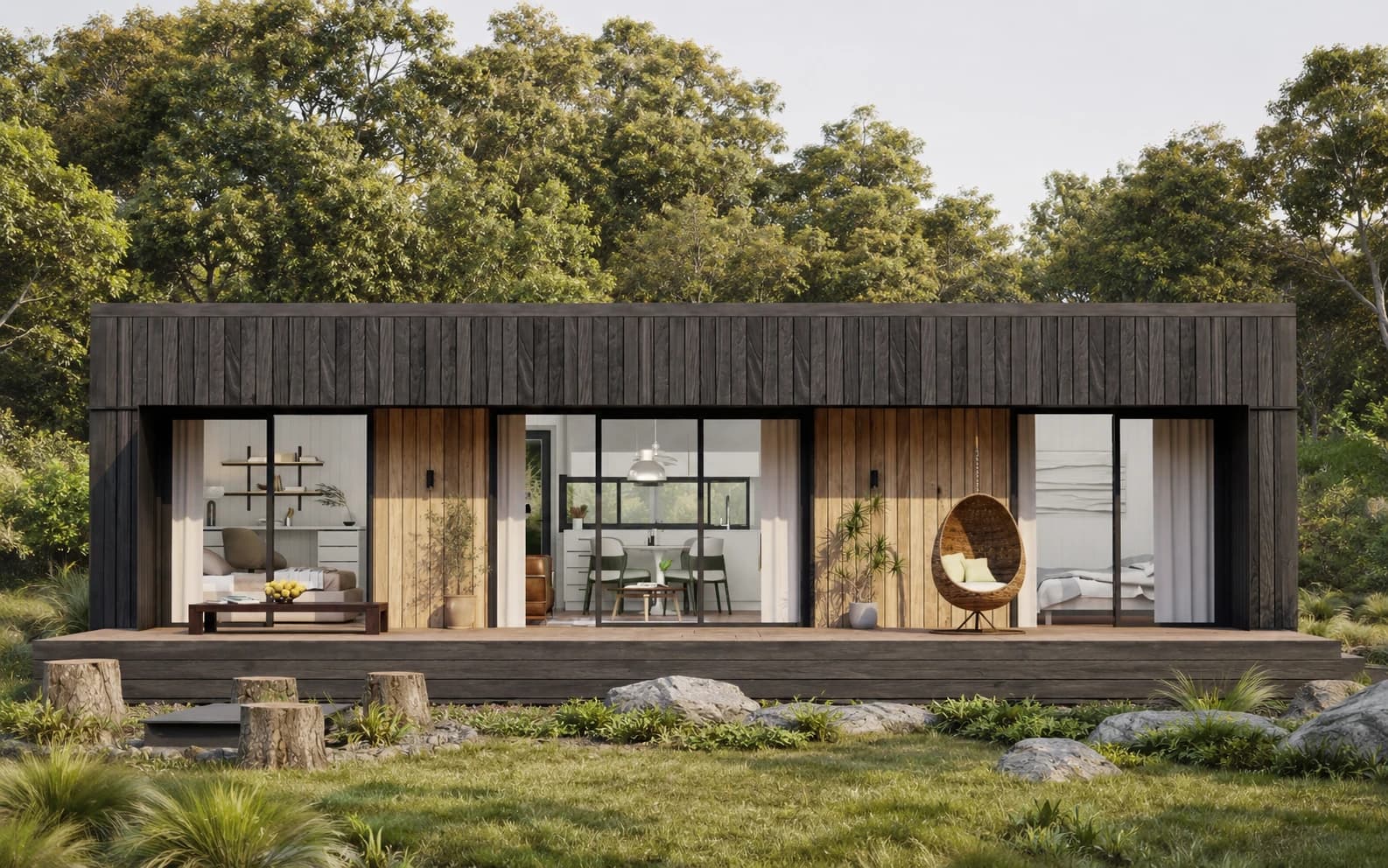
Rural land is where modular building makes the most sense — and where the site does the most to shape your project. On a country block, the home is often the easy part. Getting services to it, getting a truck down the driveway, and getting the wastewater approved are where the real decisions live. This guide covers what's genuinely different about building a modular home on rural or acreage land in Australia, so you can weigh a block properly before you buy it.
Why modular suits rural land
There's a practical reason modular homes are so common on acreage: conventional building gets harder the further you are from a city.
- 01Trade availability — regional and rural areas have fewer builders and trades, longer waits, and higher call-out costs
- 02Travel costs — every trade travelling to a remote site adds cost and time
- 03Weather exposure — a site build on an exposed rural block loses days to weather that a factory build doesn't
- 04Materials logistics — repeated deliveries to a remote site are expensive; one delivery is not
A modular home shifts the bulk of construction to a factory, so the labour, weather and logistics problems of remote building largely disappear. What you're left with is a single delivery and a site that needs to be ready for it.
That's the trade-off in one line: modular removes the construction problem and concentrates everything into the site.
Services: the biggest rural variable
On a serviced suburban block, utilities are a line item. On rural land, they can be the largest cost in the project.
Water. Mains water is often unavailable. The usual answers are rainwater harvesting with tank storage (commonly 20,000–45,000 litres for year-round supply, depending on region and roof area), a bore, or in some areas a licensed creek or dam supply with treatment. Each has different cost and approval implications.
Power. Connecting to the grid is priced by distance — running a line a long way to a remote block can cost more than an off-grid system. Many rural modular homes are solar and battery from the outset, not for ideology but because it's cheaper than the connection.
Wastewater. This is the one to resolve first. Without sewer, you need an approved on-site system — a septic tank, an aerobic treatment unit (ATU) for sensitive land, or a composting system. Crucially, on-site wastewater requires its own approval (a Section 68 approval in NSW, or the equivalent elsewhere), separate from your building approval. It's often the longest-lead item on a rural project.
Stormwater and drainage. Rural blocks need proper drainage design, particularly on slopes or in areas with heavy seasonal rain.
Access: can the home actually get there?
Rural access problems are different from suburban ones — usually not tight streets, but long distances, soft ground and low branches.
Before committing to a block, check:
- 01The full route — road width, tight corners, low bridges, and any load-limited bridges or culverts
- 02The property entrance — gateway width, entry angle, cattle grid and culvert strength
- 03The internal track — width, gradient, and whether the ground will carry a heavy truck after rain
- 04Overhead clearance — tree branches along the driveway are the single most common rural obstruction
- 05Crane standing area — if a crane is needed, it requires firm, level ground within reach of the pad
Difficult access is usually solvable — sectional delivery, smaller transport, or temporary works — but the solution needs to be chosen early, not on delivery day. (Our delivery access checklist covers this in full.)
Approvals on rural land
Rural zoning is genuinely different from residential, and the differences matter:
- 01Zoning — rural zones (RU1, RU2, RU4 in NSW; Farming Zone in Victoria; rural zones in QLD) have their own rules about what dwellings are permitted, and how many
- 02Secondary dwellings — many councils don't support secondary dwellings on rural land the way they do in residential zones. In Queensland, for example, rural zones generally aren't suited to secondary dwellings under most schemes
- 03Minimum lot sizes — rural zones often have minimum lot sizes for a dwelling, which can affect whether a block is buildable at all
- 04Bushfire — much rural land is bushfire-prone, requiring a Bushfire Attack Level (BAL) assessment and construction to that rating. This affects design, materials and cost
- 05Flood and environmental overlays — common on rural land, and can significantly change what's permitted
The single most important check before buying a rural block: confirm a dwelling is permitted on that zone and lot size, and check the overlays. It's a short conversation with the council that can save an expensive mistake.
Bushfire: plan for it, don't discover it
Bushfire is the rural consideration most likely to change a project. If your land is bushfire-prone:
- 01A BAL assessment determines the required construction standard, from BAL-Low through to BAL-FZ (flame zone)
- 02Higher BAL ratings require specific materials, window glazing, screening and sealing
- 03This affects both design and cost — potentially significantly at higher ratings
- 04It's assessed as part of planning approval, so it needs to be known before design is finalised
Modular homes can be built to BAL ratings like any home. The point is to know your rating before you design, not after.
What to check before buying rural land
- Step 01Is a dwelling permitted? Confirm the zone and minimum lot size allow what you're planning.
- Step 02What overlays apply? Bushfire, flood, environmental and vegetation overlays all shape the project.
- Step 03Where are the services? How far to power, and what's the connection cost? Is there mains water?
- Step 04What's the wastewater solution? Soil and site conditions determine whether septic, ATU or composting is viable — and it needs its own approval.
- Step 05Can a truck and crane reach the building site? Walk the full route, not just the block.
- Step 06What's the BAL rating likely to be? This affects design and budget materially.
- Step 07What's the ground like when wet? Rural delivery often depends on dry-weather timing.
Frequently asked questions
Can you build a modular home on rural land in Australia?
Yes, and rural land is one of the most common settings for modular homes — largely because conventional building is slower and more expensive in regional areas. The main considerations are services (water, power and wastewater are often not connected), delivery access down rural roads and driveways, and the approval pathway for your rural zone.
What services do you need for a modular home on acreage?
Typically water (rainwater tanks, a bore, or mains where available), power (grid connection or an off-grid solar and battery system), and wastewater (an approved on-site system such as a septic tank, aerobic treatment unit or composting system where there's no sewer). On-site wastewater requires its own approval, separate from building approval, and is often the longest-lead item.
Do you need council approval for a modular home on rural land?
Yes. Rural zones have their own rules about what dwellings are permitted, minimum lot sizes, and how many dwellings a lot can have. Many councils don't allow secondary dwellings on rural land the way they do in residential zones. Bushfire, flood and environmental overlays are also common on rural land and can change the approval pathway.
Can a modular home be delivered to a remote rural property?
In most cases yes. The considerations are the full route (road width, load limits, low bridges), the property entrance and internal track (width, gradient, ground firmness), overhead branches and power lines, and crane access if needed. Difficult access is usually handled with sectional delivery, where the home arrives in smaller sections and is assembled on site.
How does bushfire risk affect a modular home on rural land?
If the land is bushfire-prone, a Bushfire Attack Level (BAL) assessment determines the required construction standard. Higher BAL ratings require specific materials, glazing, screening and sealing, which affects design and cost. Modular homes can be built to any BAL rating — the important thing is to know your rating before finalising the design, since it's assessed during planning approval.
The bottom line
On rural and acreage land, modular building solves the hardest part — construction — and concentrates everything else into the site. Services, access, zoning and bushfire are where rural projects are won or lost, and every one of them is knowable before you buy. Walk the driveway, check the zone, ask where the power is, and find out what the wastewater solution will be. Get those right, and a rural modular build is one of the most sensible ways to put a quality home on a country block.
A ModuHaus Planning Assessment is built for exactly this — starting with your rural site, its services, access and approval pathway, before matching a home to it. If you're weighing an acreage block, that's the most useful first step you can take.
**Start your Planning Assessment →**
This article is general information only and not legal, planning or building advice. Rural zoning, services and bushfire requirements vary significantly by state, council and site. Always confirm requirements with your local council and a qualified professional before buying land or committing to a build.
Last updated: 16/07/2026.
Sources and further reading
Requirements change and can be applied differently by site and local authority. Check the current official sources and confirm your project with the relevant council, certifier or qualified professional.