
Format comparison
Portable Studio vs Expandable Home
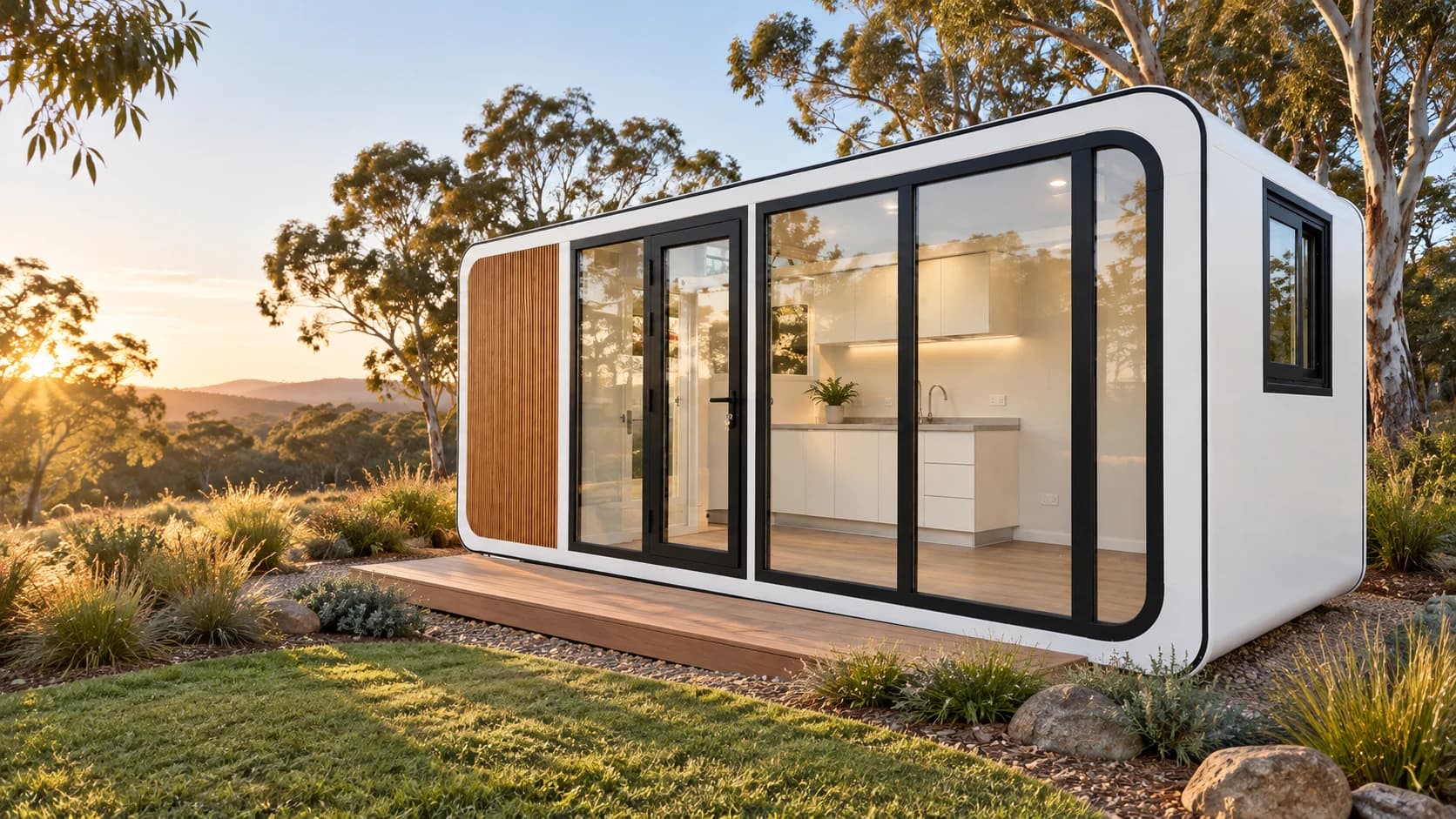
A portable studio arrives as one compact room. An expandable home travels in a compressed form and opens into a larger footprint on site. The right direction depends on intended use, space, access, services, approvals and complete project cost.
Verified 20 September 2026Updated 20 September 2026

Quick decision
Which format fits the brief?
Start with a portable studio when a compact single-room format meets the brief. Start with an expandable home when bedrooms, broader living space or a larger on-site footprint are central to the project. In both cases, confirm lawful use and site requirements before relying on the product format.
Side-by-side
Compare the published starting points.
These are product-level references, not complete project quotations. Confirm current drawings, inclusions and site-specific scope before making a purchase decision.
| Decision point | Portable studio | Expandable home |
|---|---|---|
| Representative model | The Halo 20 | The Cove Studio |
| Transport and setup | Delivered as one complete 20ft studio; no unfolding stage | Delivered in a compact 20ft form and expanded on site |
| Published area | Approx. 13.0 m2 | Approx. 36.74 m2 when expanded |
| Layout direction | Open studio with kitchenette reference and 1 bathroom | One-, two- or three-bedroom directions; final bathroom set-out to confirm |
| Indicative starting point | The Halo 20 from $18,000 product only | The Cove Studio from $23,000 product only |
| Typical brief | Guest room, office, recreation room or site-specific short-stay use | Guest, holiday or broader accommodation requiring separated rooms |
| Site footprint | Compact single-piece footprint | Larger opened footprint requiring clear expansion space |
| Approval position | Not automatically approval-free or approved for habitation | Expandable format does not remove planning, building or siting requirements |
Choose a portable studio when
A compact single room meets the brief.
- One flexible room, a compact kitchenette reference and private bathroom are enough.
- The property has limited usable area or the brief values a smaller placed footprint.
- A single-piece delivery is preferable to an on-site expansion stage.
- The intended use can be clearly assessed as work, guest, recreation or accommodation space.
Choose an expandable home when
The project needs a larger living envelope.
- The brief needs separated bedrooms or materially more internal space.
- The site can accommodate both the delivery path and the larger opened footprint.
- A broader living and accommodation layout outweighs the value of the smallest format.
- The project team can coordinate expansion, supports, services and current supplier requirements on site.
Shared checks
What the format comparison cannot decide.
Product fit is only one part of the decision. These items remain specific to the property, supplier scope and intended use.
- 01Describe the intended use precisely; office, guest, short-stay and permanent residential use can lead to different requirements.
- 02Confirm delivery width, height, weight, turning space, lifting or placement method and overhead constraints.
- 03Check the final footprint, setbacks, supports or foundations, drainage and service routes against the property.
- 04Request current drawings, inclusions, certification evidence, warranty terms and written supplier pricing.
- 05Budget separately for freight, placement, approvals, professional fees, site work, services and installation.
Common questions
Before choosing between the two.
What is the main difference between a portable studio and an expandable home?Open
A portable studio is delivered as a complete single-piece room. An expandable home travels in a compact form and opens into a wider on-site footprint, allowing substantially more internal area and more separated-room layouts.
Is a portable studio easier to approve than an expandable home?Open
Not automatically. The intended use, property controls, siting, building work, services and applicable state or council pathway matter more than the product label. A compact office-only brief may differ from proposed residential accommodation.
Can either format be used as a permanent dwelling?Open
The format alone does not establish lawful residential use. Permanent occupation depends on the site, planning and building pathway, construction evidence, installation, services and any occupancy requirements for the project.
Is the displayed starting price the complete installed cost?Open
No. The figures are indicative product starting points. Complete project cost can also include specification changes, freight, placement, approvals, foundations or supports, site work, services, installation and professional fees.
Which format is easier to deliver?Open
A smaller single-piece studio can reduce some placement demands, but delivery still depends on dimensions, weight, access, turning space and lifting requirements. An expandable product also needs sufficient clear space and a coordinated process for opening and supporting the home on site.
Evidence and scope
The Halo 20
3 evidence records · Verified 14 September 2026
4 matters remain subject to supplier, project or site confirmation. Next review by 13 December 2026.
The Cove Studio
3 evidence records · Verified 14 September 2026
4 matters remain subject to supplier, project or site confirmation. Next review by 13 December 2026.
- Current Halo 20, Vista 20 and Cove Studio supplier quotation references
- Current portable-studio and expandable-home plan and dimension references
- ModuHaus product configuration, pricing scope and site-review notes
This comparison is general product information, not planning, building, engineering, certification or financial advice. Product specifications and pricing can change. Confirm the current written supplier scope and requirements for the property before proceeding.
How product data is verifiedPlanning Assessment
Compare the site before committing to the format.
Share the property, intended use and access details so ModuHaus can help turn the preferred product into a clearer project brief.